
Marine Education
What Do You Need to Fish? Complete USA Beginner Guide
Sep
If you’re wondering what do you need to fish, the basic answer is simple: a legal fishing license when required, a rod and reel, fishing line, hooks, bait or lures, basic tackle, and a safe place to fish. Beginners do not need an expensive collection of equipment to get started.
According to Take Me Fishing’s beginner fishing guide, a simple freshwater setup can include a spinning rod and reel, line, hooks, bait, bobbers, sinkers, a few lures, and pliers. The organization also recommends checking licensing requirements before fishing.
For anglers building a freshwater setup, Fisherman Fleet is a useful place to explore rods, reels, fishing line, hooks, lures, tackle storage, and other equipment.
This guide also answers related bass-fishing questions, including what do black bass eat, what do freshwater bass eat, what do bass eat in ponds, how big bass can get, where largemouth bass live, and how to determine what fish are biting right now.
Table of Contents
- What Do You Need to Fish?
- Beginner Fishing Gear Checklist
- What Do Black Bass Eat?
- What Do Freshwater Bass Eat?
- What Do Bass Eat in Ponds?
- What Do Big Bass Eat?
- Largemouth Bass Habitat
- How Big Can Bass Get?
- Where Do Largemouth Bass Live?
- LMB Fishing Tips
- Where Are the Fish Biting Near Me?
- What Fish Are in Season Right Now?
- Frequently Asked Questions
- Conclusion
What Do You Need to Fish?
For basic freshwater fishing, you need only a manageable collection of equipment.
Take Me Fishing identifies the core freshwater essentials as a rod, reel, fishing line, hook, and bait or lure matched to the species you plan to catch.
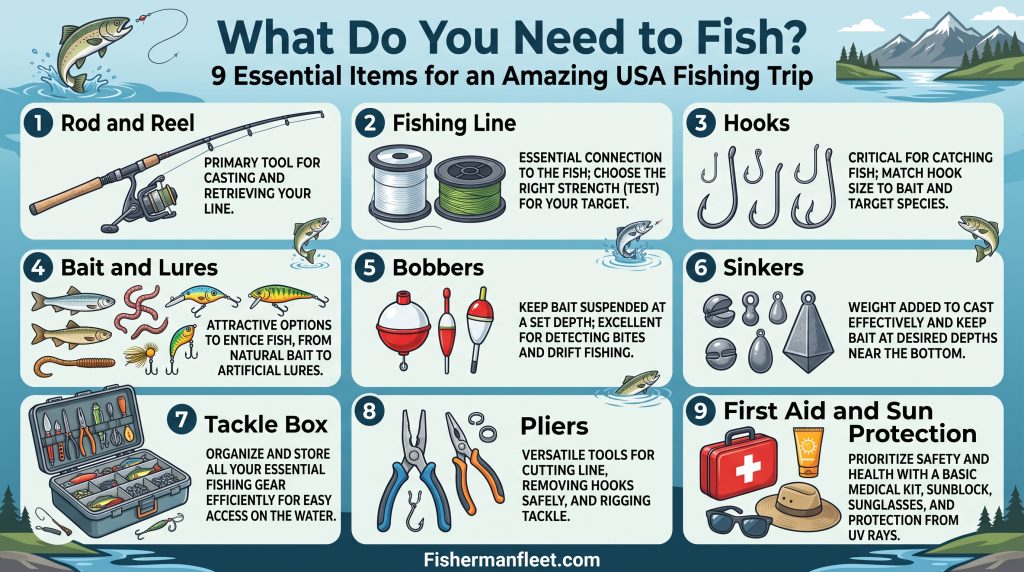
A practical beginner setup includes:
- Fishing license where required
- Rod and reel
- Fishing line
- Hooks
- Sinkers
- Bobbers
- Bait or artificial lures
- Pliers
- Line cutter
- Small tackle box
- Appropriate clothing
- Drinking water
- Basic safety equipment
A fishing license is particularly important. Rules vary by state, age, species, season, and body of water, so check the responsible state wildlife agency before fishing.
What Do You Need to Go Fishing for the First Time?
For a first trip, simplicity usually works better than carrying too much equipment.
Rod and Reel
A spinning combination is an approachable choice for beginners.
Take Me Fishing’s beginner gear guidance recommends starting with a six- or seven-foot spinning rod and reel combination for general use.
For freshwater beginners, the organization also notes that a 1000 to 3000 size spinning reel paired with a roughly 7-foot medium-action rod can provide a versatile learning setup.
Fishing Line
Your line should match both your reel and target species.
For panfish, lighter line is usually sufficient.
Bass and catfish commonly require somewhat stronger line.
Hooks
Keep several sizes available rather than relying on one hook for every fish.
Your hook should match:
- Target species
- Bait size
- Fishing method
Bait or Lures
Beginners can start with live bait such as worms or straightforward artificial lures such as small jigs, spinnerbaits, or soft plastics.
Pliers and Line Cutters
Needle-nose pliers help remove hooks safely, while scissors or a dedicated line cutter make rigging much easier.
Tackle Storage
A compact tackle box helps organize:
- Hooks
- Sinkers
- Swivels
- Bobbers
- Lures
- Leaders
You can browse beginner-friendly tackle and fishing equipment through Fisherman Fleet.
What Do Black Bass Eat?
The term black bass generally refers to species in the genus Micropterus, including largemouth bass, smallmouth bass, and spotted bass.
Their diets vary with age, habitat, prey availability, and fish size.
Adult largemouth bass commonly eat:
- Small fish
- Crayfish
- Frogs
- Large aquatic invertebrates
The U.S. Fish and Wildlife Service largemouth bass profile states that adult largemouth bass feed on fish, crayfish, and frogs, while younger fish consume crustaceans, insects, and small fish.
Largemouth bass are opportunistic predators.
When available, their prey can also include unusual items such as small terrestrial animals that enter the water.
What Do Freshwater Bass Eat?
If you’re asking what do freshwater bass eat, think primarily about the prey available in their environment.
Common bass food includes:
Baitfish
Examples can include:
- Shad
- Minnows
- Shiners
- Juvenile sunfish
Crayfish
Crayfish are especially important around rocky or hard-bottom habitat.
Frogs
Bass frequently target frogs around vegetation and shoreline cover.
Insects and Aquatic Invertebrates
Young bass consume many insects and small crustaceans.
Smaller Fish
Large bass are capable predators and may consume smaller bass or other appropriately sized fish.
Texas Parks and Wildlife similarly reports that adult largemouth bass feed mainly on other fish and large invertebrates such as crayfish.
Bass Diet Changes as Fish Grow
The bass diet changes substantially with age.
Newly Hatched Bass
Young fry initially consume extremely small organisms such as zooplankton.
Juvenile Bass
As they grow, they begin eating:
- Insect larvae
- Small crustaceans
- Tiny fish
Adult Bass
Adults increasingly become fish-oriented predators.
The U.S. Fish and Wildlife Service reports that young largemouth bass shift toward feeding on insects and small fish as they grow, while adults consume larger prey such as fish, frogs, and crayfish.
This dietary change explains why lure selection often changes according to the size of bass being targeted.
What Do Bass Eat in Ponds?
Bass living in ponds commonly eat whatever prey is abundant and appropriately sized.
Typical pond forage includes:
- Bluegill
- Small sunfish
- Minnows
- Frogs
- Crayfish
- Insects
- Tadpoles
In many managed ponds, bluegill become an important food source for largemouth bass.
The exact diet depends heavily on what the pond contains.
If a pond has abundant crayfish, bottom-oriented jigs and craw-style soft plastics can imitate an important food source.
If small sunfish dominate, swimbaits and other baitfish-style lures may be productive.
Food for Bass: Matching Your Lure to Their Diet
Understanding natural food for bass helps anglers choose more realistic lures.
When Bass Eat Small Fish
Consider:
- Crankbaits
- Swimbaits
- Jerkbaits
- Spinnerbaits
When Bass Eat Crayfish
Consider:
- Jigs
- Craw-style plastics
- Bottom-oriented crankbaits
When Bass Eat Frogs
Try:
- Hollow-body frogs
- Surface lures
- Weedless soft plastics
When Bass Feed on Insects or Small Prey
Finesse presentations can become useful.
The goal is not necessarily to copy prey perfectly. Rather, imitate its approximate size, movement, depth, and location.
What Do Big Bass Eat?
Large bass generally require more energy than smaller fish, so they are capable of eating substantial prey.
What do big bass eat?
Common prey can include:
- Larger baitfish
- Bluegill
- Shad
- Crayfish
- Frogs
- Other fish
Large bass do not always chase the largest available meal, though.
They may still eat relatively small prey when it is abundant and easy to capture.
For anglers, this means a trophy-size bass can potentially strike both a large swimbait and a smaller finesse lure.
Habitat for Largemouth Bass
Good habitat for largemouth bass combines food, cover, appropriate water quality, and places suitable for reproduction.
The U.S. Fish and Wildlife Service reports that largemouth bass inhabit clear, vegetated lakes, ponds, swamps, and backwaters of rivers and creeks. Adults commonly use submerged vegetation as ambush cover.
Important habitat features include:
- Aquatic vegetation
- Fallen trees
- Submerged logs
- Docks
- Stumps
- Creek channels
- Points
- Shoreline cover
- Backwaters
Bass often position themselves near cover where they can ambush prey.
Where Do Largemouth Bass Live?
Where do largemouth bass live?
They occur widely across North America and have also been introduced outside their historical native range.
Within North America, the U.S. Fish and Wildlife Service identifies their range as extending through areas associated with the St. Lawrence River, Great Lakes, Mississippi River basin, Atlantic drainages from North Carolina to Florida, and into northern Mexico.
Largemouth bass can inhabit:
Lakes
Especially vegetated lakes with adequate forage.
Reservoirs
Many major American reservoirs support excellent largemouth fisheries.
Ponds
Farm ponds and managed recreational ponds can contain strong bass populations.
Rivers
Bass frequently occupy slower sections, backwaters, vegetation, woody cover, and current breaks.
Swamps and Wetlands
Warm, productive wetland environments can also provide suitable habitat.
Bass Size: How Big Can Bass Get?
The question how big bass can get depends on which bass species you’re discussing.
For largemouth bass, the U.S. Fish and Wildlife Service reports a common length of about 16 inches, while the longest reported specimen listed by the agency measured 38.2 inches. The heaviest reported largemouth bass weight in its species profile is 22 pounds.
That does not mean most anglers will regularly encounter 20-pound fish.
Most bass are considerably smaller.
Bass Fish Size by Age
Growth rates vary considerably according to:
- Climate
- Food abundance
- Water temperature
- Population density
- Habitat quality
- Genetics
Texas Parks and Wildlife reports approximate largemouth growth in Texas of:
First year: 4–6 inches
Two years: 8–12 inches
Three years: around 16 inches
These figures are regional examples rather than universal growth rules.
Northern bass frequently grow more slowly because cooler temperatures shorten their annual growing season.
LMB Fishing: What Does LMB Mean?
LMB fishing simply means largemouth bass fishing.
“LMB” is a common shorthand used by anglers for largemouth bass.
Popular LMB fishing techniques include:
- Texas rigs
- Carolina rigs
- Jigs
- Spinnerbaits
- Crankbaits
- Jerkbaits
- Swimbaits
- Topwater lures
- Drop shots
- Ned rigs
The best presentation depends on water temperature, season, depth, available cover, and forage.
Simple LMB Fishing Setup for Beginners
A beginner largemouth bass setup does not need to be complicated.
A versatile option is:
Rod: 6’6″–7′ medium-action spinning rod
Reel: 2500-size spinning reel
Line: Appropriate monofilament, fluorocarbon, or braid according to technique
Lures: Soft plastics, spinnerbaits, small crankbaits, and jigs
This allows beginners to experiment with several techniques without buying multiple specialized combinations.
For rods, reels, fishing line, lures, hooks, and tackle storage, visit Fisherman Fleet.
Where Are the Fish Biting Near Me?
The keyword where are the fish biting near me requires local and current information.
Fish activity can change daily because of:
- Water temperature
- Weather
- Barometric changes
- Seasonal migrations
- Water clarity
- Current
- Tides
- Forage movement
Rather than relying on a nationwide answer, check local sources such as:
- State wildlife agency fishing reports
- Local bait and tackle shops
- Marina reports
- Fishing clubs
- Recent angler reports
Take Me Fishing’s Places to Fish and Boat resources can also help identify fishing waters near your location.
What Fish Is Biting Right Now?
The answer to what fish is biting right now depends on your location and today’s conditions.
In freshwater, likely targets can include:
- Bass
- Crappie
- Bluegill
- Catfish
- Trout
- Walleye
- Pike
- Perch
One lake may have an excellent crappie bite while a nearby reservoir is producing bass.
The most useful current information usually comes from recent local fishing reports rather than general seasonal guides.
What Fish Are Running Right Now?
The phrase what fish are running right now often refers to migratory species moving through rivers, shorelines, passes, or coastal areas.
Examples can include:
- Salmon
- Steelhead
- Striped bass
- American shad
- Various coastal species
Run timing varies substantially by region and can change from year to year.
Always check local fisheries agencies before planning around a migration.
What Fish Is in Season Now?
The question what fish is in season now can refer to two different things.
First, it may mean which species are currently active and worth targeting.
Second, it may mean which species are legally open for harvest.
These are not necessarily the same thing.
A fish may be actively feeding but subject to:
- Closed seasons
- Size restrictions
- Bag limits
- Gear restrictions
Therefore, check current state regulations before fishing or keeping any catch.
What Fish Are in Season Right Now?
For what fish are in season right now, your state wildlife agency is the best authority.
Seasonal opportunities can vary even within the same state because different lakes, rivers, management zones, and species may have separate regulations.
The U.S. Fish and Wildlife Service can provide broader conservation and fisheries information, but anglers should use their state fish and wildlife department for the exact current fishing regulations that apply to a location.
American Freshwater Fish
The United States contains a remarkable diversity of American freshwater fish.
Well-known examples include:
- Largemouth bass
- Smallmouth bass
- Bluegill
- Crappie
- Channel catfish
- Blue catfish
- Flathead catfish
- Rainbow trout
- Brook trout
- Walleye
- Yellow perch
- Northern pike
- Muskellunge
- Freshwater drum
- Carp
Each species requires a slightly different combination of habitat, tackle, bait, and fishing strategy.
This is one reason learning to identify the target fish before buying equipment can save beginners both money and frustration.
Frequently Asked Questions
What do you need to fish?
For basic freshwater fishing, you generally need a fishing license where required, rod and reel, line, hooks, bait or lures, sinkers or other terminal tackle, pliers, and suitable safety equipment. Take Me Fishing provides a beginner checklist covering these essentials.
What do you need to go fishing for the first time?
A simple spinning combination, fishing line, hooks, bait or a few lures, sinkers, pliers, tackle storage, and the appropriate license are enough for many first freshwater trips.
What do black bass eat?
Adult largemouth bass commonly eat fish, crayfish, and frogs, while young bass consume insects, crustaceans, and small fish.
What do freshwater bass eat?
Freshwater bass commonly eat baitfish, crayfish, insects, frogs, and other smaller aquatic animals.
What do bass eat in ponds?
Pond bass commonly eat bluegill, minnows, small sunfish, crayfish, insects, tadpoles, and frogs depending on local forage.
What do big bass eat?
Large bass frequently eat larger baitfish, bluegill, shad, crayfish, frogs, and other fish, although they can still take smaller prey.
Where do largemouth bass live?
Largemouth bass inhabit lakes, ponds, reservoirs, swamps, creeks, rivers, and vegetated backwaters.
How big can bass get?
The U.S. Fish and Wildlife Service lists the heaviest reported largemouth bass at 22 pounds and the longest reported specimen at 38.2 inches.
Where are the fish biting near me?
Check recent reports from your state wildlife agency, bait shops, marinas, local anglers, and Take Me Fishing’s fishing-location resources.
What fish are in season right now?
It depends on your location, species, and regulations. Always check the current rules published by the state wildlife agency responsible for the waters you plan to fish.
Conclusion
Understanding what do you need to fish makes starting much easier than many new anglers expect. A basic rod-and-reel combination, fishing line, hooks, bait or lures, terminal tackle, pliers, and the required fishing license are enough for many freshwater trips. Take Me Fishing provides additional beginner guidance for assembling a practical first setup.
For bass anglers, understanding the fish is just as important as buying equipment. The U.S. Fish and Wildlife Service identifies fish, crayfish, and frogs as important adult largemouth bass prey and describes vegetated lakes, ponds, swamps, rivers, and backwaters as key habitat.
Knowing what freshwater bass eat, where they live, and how their diet changes makes it easier to choose productive lure styles and fishing locations.
When searching where are the fish biting near me or what fish is biting right now, prioritize recent local reports because fishing conditions can change quickly. Always verify current seasons, bag limits, and other regulations before keeping fish.
For rods, reels, lures, fishing line, hooks, tackle boxes, and other equipment for bass and freshwater fishing, explore Fisherman Fleet.
