

Marine Education
What Are Antique Vintage Fishing Lures? Complete USA Collector Guide
Sep
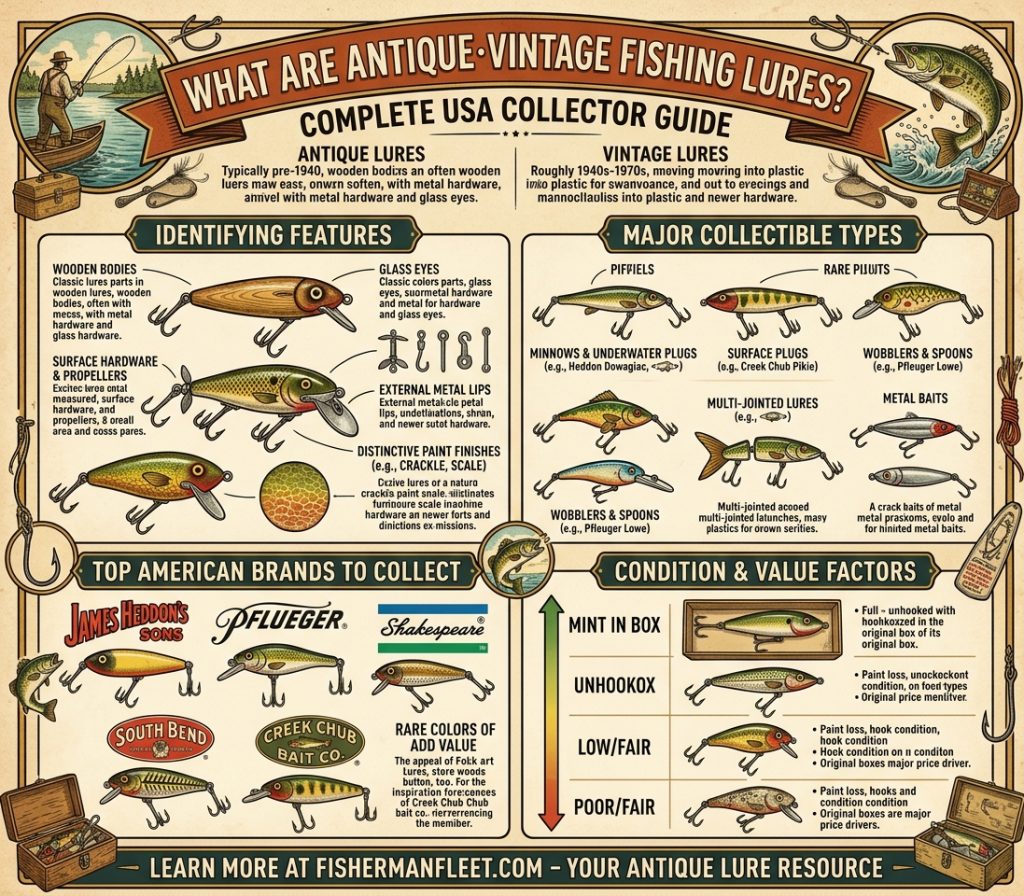
Antique vintage fishing lures are older artificial fishing baits collected for their age, manufacturer, design, rarity, condition, historical significance, unusual colors, or original packaging. They can include wooden plugs, metal spoons, vintage spinning lures, early plastic baits, topwater lures, minnow-style plugs, and many unusual designs from earlier periods of American fishing.
Although anglers originally purchased these lures to catch fish, some eventually became collectible fishing lures. Consequently, an old lure found inside a forgotten tackle box could be ordinary used fishing tackle, an interesting piece of fishing history, or occasionally a sought-after collectible.
Fishing lures are part of the broader category of fishing tackle. The U.S. Fish and Wildlife Service beginner fishing guide includes fishing lures among the basic tackle anglers can use when fishing.
For current rods, reels, hooks, artificial lures, fishing line, and tackle storage, anglers can also explore Fisherman Fleet.
Table of Contents
- What Are Antique Vintage Fishing Lures?
- Antique vs. Vintage Fishing Lures
- How to Identify Old Fishing Lures
- What Makes Fishing Lures Collectible?
- Popular Vintage Spinning Lures
- Antique Fishing Lure Pictures
- Old Fishing Lures for Sale
- Vintage PENN Fishing Reels
- How to Identify an Old PENN Reel
- VMC Fishing Hooks
- How to Store Vintage Fishing Tackle
- Frequently Asked Questions
- Conclusion
What Are Antique Vintage Fishing Lures?
An antique or vintage fishing lure is an artificial bait manufactured during an earlier period of fishing history.
Older lures may be constructed from:
- Wood
- Metal
- Early plastics
- Rubber
- Hair
- Feathers
- Glass components
- Natural materials
The exact materials depend heavily on the manufacturer and production period.
Artificial lures have also taken many forms. The U.S. Fish and Wildlife Service fishing equipment definition recognizes artificial lures, flies, baits, hooks, sinkers, swivels, rods, reels, lines, and tackle boxes as different components of fishing equipment.
Early lure manufacturers experimented with different ways to imitate prey.
Some lures used spinning blades to produce flash.
Others used wooden bodies shaped like minnows.
Surface lures sometimes incorporated propellers, while metal spoons used their shape to create wobbling movement.
Because of these differences, antique tackle provides an interesting physical record of how recreational fishing equipment developed.
Antique vs. Vintage Fishing Lures
The terms antique fishing lure and vintage fishing lure are frequently used interchangeably in online listings.
However, they do not necessarily mean exactly the same thing.
“Antique” generally implies substantial age. Meanwhile, “vintage” is often used more broadly for tackle associated with an earlier recognizable manufacturing period.
There is no single universal fishing-industry rule that automatically makes every lure vintage or antique after one exact number of years.
Therefore, collectors should identify:
- Manufacturer
- Model
- Approximate production period
- Construction
- Hardware
- Materials
- Original packaging
Do not assume a lure is genuinely rare simply because an online seller calls it a “rare antique fishing lure.”
How to Identify Antique Vintage Fishing Lures
Correct identification usually requires examining several details together.
Manufacturer Markings
Check carefully for:
- Manufacturer names
- Logos
- Patent numbers
- Model names
- Numbers
- Stamped lettering
- Country-of-origin markings
Even a small marking can provide a useful starting point for research.
Body Material
Determine whether the lure is made from wood, metal, plastic, rubber, or another material.
Older wooden lures are particularly interesting to many collectors. However, being wooden does not automatically make a lure antique or valuable.
Hardware
Look closely at:
- Hook hangers
- Screw eyes
- Propellers
- Diving lips
- Line ties
- Split rings
- Hooks
Hardware designs changed as fishing tackle manufacturing evolved.
Paint and Finish
Original paint can be important.
Look for:
- Original color
- Pattern
- Eye design
- Manufacturer markings
- Natural aging
- Evidence of repainting
A freshly repainted lure may look attractive, but collectors may prefer an original finish even when it shows wear.
Original Packaging
Original boxes can provide excellent identification information.
Packaging may show:
- Manufacturer
- Model
- Color
- Size
- Patent information
- Instructions
- Advertising
- Original price
Therefore, never throw away an old lure box before researching it.
What Makes Collectible Fishing Lures Valuable?
Not every old lure is valuable.
Collector interest can depend on several factors.
Rarity
Limited-production models or unusual variations may be more difficult to locate.
However, rarity alone does not guarantee value. There must also be collector demand.
Manufacturer
Certain historical lure manufacturers have dedicated collector communities.
Condition
Collectors commonly inspect:
- Original paint
- Chips
- Cracks
- Rust
- Hook condition
- Missing hardware
- Repairs
- Modifications
Original Box
A correct original box can make a lure more interesting to collectors.
Historical Importance
Some fishing lures represent important developments in tackle design or are associated with historically significant manufacturers.
Unusual Colors
A common lure produced in an uncommon color can sometimes be more collectible than the standard version.
Provenance
Documentation explaining where an item originated can provide additional historical interest.
Collectible Fishing Lures vs. Simply Old Fishing Lures
There is an important difference between something being old and something being collectible.
Imagine two fishing lures manufactured during the same decade.
One was produced in enormous numbers and remains easy to find.
The other had a short production run and survives in an unusual original color with its matching box.
Both are old.
However, collectors may consider the second lure much more desirable.
Therefore, collectors should consider:
Age + rarity + condition + originality + demand + historical significance.
Age alone is not enough.
Vintage Spinning Lures
Vintage spinning lures represent an important part of fishing-tackle history.
A spinner typically incorporates a rotating blade that creates flash and vibration when retrieved through the water.
Spinner-style lures have been used for species such as:
- Trout
- Bass
- Pike
- Perch
- Salmon
- Panfish
A typical older spinner may contain:
- Wire shaft
- Metal blade
- Weighted body
- Hook
- Hair or feather dressing
Modern spinners still operate on similar basic principles, although materials and manufacturing methods have changed.
Vintage Metal Spoons
Spoons are another classic lure category.
A fishing spoon normally has a curved metal body that creates a wobbling or fluttering action as it moves through the water.
Older examples may feature:
- Stamped manufacturer names
- Painted finishes
- Hammered metal
- Brass-colored finishes
- Copper-colored finishes
- Nickel finishes
- Decorative patterns
However, metal construction does not automatically indicate age.
Modern fishing spoons continue to use similar basic designs.
Vintage Wooden Fishing Lures
Wooden plugs are among the most recognizable types of antique vintage fishing lures.
Depending on their design, they may imitate:
- Minnows
- Frogs
- Injured baitfish
- Surface prey
Older wooden lures may feature:
- Glass eyes
- Painted eyes
- Propellers
- Metal diving lips
- Screw-eye hardware
- Multiple treble hooks
If you discover an unidentified wooden lure, avoid immediately sanding or repainting it.
The faded finish you want to remove could be original.
Antique Fishing Lures Pictures: Why Photos Matter
People frequently search for antique fishing lures pictures because photographs can help with identification.
If you’re trying to identify a lure, take clear photographs of:
- Left side
- Right side
- Top
- Bottom
- Front
- Rear
- Hooks
- Line attachment
- Manufacturer markings
- Packaging
Place a ruler next to the lure so its dimensions are visible.
Detailed photographs make it easier to compare the lure with catalog images, collector references, and documented examples.
The U.S. Fish and Wildlife Service tackle box and fishing lures photograph is also an example of an authoritative public-domain fishing-tackle image resource.
How to Research an Unknown Fishing Lure
Start with whatever information appears physically on the lure.
Suppose the lure says:
Manufacturer Name – Model 100
Search the exact manufacturer and model instead of simply searching “old fishing lure.”
Then compare:
- Body shape
- Length
- Paint
- Eye style
- Hook arrangement
- Hardware
- Logo
- Packaging
Historical manufacturer catalogs can be especially useful.
Collector books, museums, fishing clubs, tackle organizations, and established auction archives can provide additional evidence.
Old Fishing Lures for Sale: What Buyers Should Check
When searching old fishing lures for sale, don’t rely entirely on a seller’s title.
Words such as:
- Rare
- Antique
- Vintage
- Collectible
- Museum quality
are descriptions, not authentication.
Instead, ask:
Is the paint original?
Has the lure been repaired?
Are the hooks original?
Has any hardware been replaced?
Does the box actually belong to this lure?
Are manufacturer markings visible?
Are detailed photographs available?
Can the approximate production period be documented?
These questions become increasingly important as the asking price increases.
How to Determine What an Old Fishing Lure Is Worth
One of the biggest mistakes in vintage-tackle collecting is treating an online asking price as market value.
A seller can ask almost any price.
Instead, compare actual documented sales of the same model.
Look for examples matching:
- Manufacturer
- Model
- Size
- Color
- Production period
- Hardware
- Condition
- Packaging
A seemingly minor variation can matter to specialized collectors.
Therefore, avoid assuming that two similar-looking lures have identical values.
Vintage PENN Fishing Reels
Collecting historical fishing equipment extends well beyond lures.
Vintage PENN fishing reels are particularly interesting because PENN has a long history in American fishing tackle.
According to PENN Fishing’s official company history, Otto Henze founded PENN Fishing Tackle Manufacturing Company in Philadelphia in 1932. The company began selling reels to the public in 1933.
Early reel names included:
- Sea Hawk
- Bayside
- Long Beach
In 1936, PENN introduced the famous Senator reel.
This long manufacturing history means collectors can encounter many different generations of old PENN fishing reels.
PENN Vintage Reels and Fishing History
PENN vintage reels appeal to different types of collectors.
Some specialize in early saltwater reels.
Others collect:
- Senators
- Long Beach reels
- Peerless reels
- Particular reel sizes
- Specific production periods
- Boxed examples
- Unusual variations
PENN’s history also continued expanding during the mid-20th century.
The company’s official historical record states that the Peerless No. 9 appeared in 1953 for light-tackle and general freshwater fishing. By 1959, PENN reported manufacturing 77 reel models.
These dates can provide useful reference points when researching an old reel.
The Vintage PENN Senator
The Senator is particularly important when discussing old PENN reels.
PENN’s current Senator reel page confirms that the Senator series was first launched in 1936.
However, there is an important collector lesson here.
The Senator name is still in use today.
PENN currently maintains a Senator collection containing modern Senator reels and combinations.
Therefore, seeing “PENN Senator” printed on a reel does not automatically prove that it is a 1930s reel.
You need to determine its exact version and production period.
How to Identify an Old PENN Reel
If you find an old PENN reel, inspect it carefully before trying to determine its value.
Look for:
- Model name
- Model number
- PENN logo
- Side-plate markings
- Reel size
- Spool design
- Handle design
- Country-of-origin markings
- Original box
- Included paperwork
Next, compare those features with reliable historical information.
PENN’s official history is a strong starting point because it provides documented dates for several important early reel families.
Vintage PENN Fishing Reels for Sale
When evaluating vintage PENN fishing reels for sale, determine whether you want the reel for collecting, display, restoration, or actual fishing.
A collector may prioritize:
- Originality
- Cosmetic condition
- Original packaging
- Correct components
An angler may prioritize:
- Mechanical operation
- Drag performance
- Spool condition
- Handle operation
- Availability of replacement parts
The two goals are not always identical.
A beautifully preserved reel may be more valuable as a collectible than as everyday fishing equipment.
Old PENN Fishing Reels vs. Modern Models
Modern manufacturing has changed reel technology considerably.
Nevertheless, several historic PENN names have survived.
For example, the modern PENN Senator reel retains a model lineage that PENN dates to 1936.
PENN also currently produces the US Senator conventional reel, which uses modern materials and components.
Consequently, collectors must distinguish between the history of a model name and the manufacturing date of an individual reel.
VMC Hooks
VMC hooks are another common fishing-tackle search term.
Hooks are fundamental terminal tackle used across freshwater and saltwater fishing.
Different hook designs are intended for different:
- Species
- Baits
- Lures
- Rigging methods
- Fishing techniques
Therefore, the words VMC fishing hooks alone do not identify one particular hook style.
When selecting any replacement fishing hook, consider:
- Hook size
- Hook pattern
- Wire strength
- Point style
- Eye design
- Intended lure or bait
- Target species
VMC Fishing Hooks and Vintage Lure Restoration
Modern hooks can be useful when preparing an old fishing lure for actual use.
Suppose you discover an older plug with badly rusted treble hooks.
If the lure is common and you intend to fish with it, replacing damaged hooks may improve safety and functionality.
However, the decision changes if the lure is collectible.
Original hardware can be part of the item’s historical integrity.
Therefore, identify the lure before modifying it.
Should You Replace Hooks on Collectible Fishing Lures?
Consider your objective first.
If You Want to Fish the Lure
Replacing badly corroded hooks can make sense.
You can preserve the original hooks separately.
If You Want to Collect the Lure
Avoid unnecessary modifications until you understand its potential significance.
Changing:
- Hooks
- Split rings
- Propellers
- Screw eyes
- Paint
can alter the originality of the item.
Photograph everything before performing restoration work.
Should You Fish With Antique Fishing Lures?
Many old fishing lures could theoretically still catch fish.
However, using a collectible lure creates risks.
You could:
- Lose it
- Break it
- Damage the paint
- Bend original hardware
- Lose an original hook
- Damage a wooden body
Therefore, consider rarity, value, condition, and sentimental importance before tying an old lure onto your line.
If you want to fish a classic design without risking an original collectible, a modern lure with similar action may be the better option.
For modern fishing lures and other tackle intended for regular use, browse Fisherman Fleet.
How to Clean Antique Fishing Lures
Cleaning old fishing tackle should be conservative.
Avoid immediately using:
- Sandpaper
- Paint stripper
- Aggressive metal polish
- Strong solvents
- Harsh cleaning chemicals
These can permanently alter original finishes and markings.
Research the lure before cleaning it.
If it appears potentially rare or historically important, preservation may be preferable to restoration.
How to Store Collectible Fishing Lures
Good storage can help preserve older tackle.
Protect collectible lures from:
- Excessive moisture
- Direct sunlight
- Extreme temperature changes
- Corrosive materials
- Repeated physical contact
Hooks should not constantly scrape against painted lure bodies.
Individual compartments or protective displays can help.
Additionally, keep documentation with the item.
If you know who originally owned it, where it was purchased, or approximately when it was acquired, record that information.
Building a Vintage Fishing Tackle Collection
A collection becomes easier to research when it has a theme.
Possible specialties include:
- Antique wooden lures
- Vintage spinning lures
- Vintage bass lures
- Antique saltwater lures
- Vintage spoons
- Specific manufacturers
- Vintage PENN reels
- Original-box lures
- Particular decades
- Unusual colors
Specialization helps collectors learn the small differences that separate common examples from unusual variations.
Antique Fishing Tackle vs. Modern Fishing Gear
Collecting historical tackle and enjoying modern fishing can complement each other.
Vintage equipment demonstrates how angling technology developed.
Modern equipment provides current anglers with contemporary materials, manufacturing, and designs.
The U.S. Fish and Wildlife Service fishing guide identifies rods, reels, line, hooks, weights, bobbers, bait, and fishing lures among basic freshwater fishing equipment.
For modern rods, reels, fishing line, hooks, lures, tackle boxes, and fishing accessories, explore Fisherman Fleet.
Frequently Asked Questions
What are antique vintage fishing lures?
They are older artificial fishing baits that may be collected because of their age, manufacturer, rarity, design, condition, historical importance, or original packaging.
Are all old fishing lures valuable?
No. Age alone does not determine value. Rarity, demand, condition, originality, manufacturer, color variation, and packaging can all influence collector interest.
How do I identify an antique fishing lure?
Check its manufacturer markings, material, hardware, paint, dimensions, patent information, hook arrangement, and packaging. Compare those characteristics with documented examples.
Where can I find antique fishing lure pictures?
Museum collections, collector references, historical catalogs, established auction archives, and public resources can help. The U.S. Fish and Wildlife Service fishing lure image collection is one example of an authoritative public fishing-tackle image source.
What are collectible fishing lures?
They are fishing lures sought by collectors because of characteristics such as rarity, manufacturer, age, design, historical significance, condition, or original packaging.
Are vintage spinning lures collectible?
They can be. Manufacturer, age, rarity, originality, condition, and collector demand are more important than simply being an older spinner.
What are vintage PENN fishing reels?
They are older reels manufactured by PENN. PENN’s official history dates the company’s founding to 1932 and public reel sales to 1933.
What were some early PENN fishing reels?
PENN identifies Sea Hawk, Bayside, and Long Beach among its early reel names. The Senator followed in 1936.
Are old PENN fishing reels valuable?
Some can be collectible, but being old does not automatically make a reel valuable. Exact model, age, rarity, condition, originality, packaging, and collector demand should all be considered.
Is the PENN Senator an old reel?
The Senator lineage is old. PENN’s Senator history and current model page states that the series was first launched in 1936. However, PENN continues producing Senator models today, so an individual Senator must be dated separately.
What are VMC hooks?
VMC hooks are fishing hooks available in different patterns and sizes for different fishing techniques. When selecting a hook, match its design and size to the target fish, bait, lure, and rigging method.
Should I replace the hooks on an antique lure?
For a lure intended for fishing, replacing unsafe hooks may be appropriate. For a collectible, original hardware may matter, so identify and document the lure before modifying it.
Can antique fishing lures still catch fish?
Many can, assuming their structure and hardware remain sound. However, fishing a rare or valuable lure creates the risk of losing or damaging it.
Conclusion
Antique vintage fishing lures provide a fascinating connection between modern angling and earlier generations of fishing-tackle design.
Wooden plugs, metal spoons, vintage spinning lures, early artificial baits, unusual hardware, and original boxes can all provide clues about how anglers and manufacturers developed new methods for attracting fish.
However, old does not automatically mean valuable.
When evaluating collectible fishing lures, consider manufacturer, model, production period, rarity, condition, original paint, hardware, packaging, and documented collector demand.
The same approach applies to vintage PENN fishing reels. PENN Fishing’s documented company history dates the company to 1932, with public reel sales beginning in 1933 and the Senator arriving in 1936.
Importantly, some historic reel names continue today. The PENN Senator collection demonstrates that the Senator remains a current reel family. Therefore, collectors should never date an individual reel solely from its model name.
If you discover old tackle, photograph it carefully before cleaning or modifying anything. Preserve boxes and paperwork, document markings, and research the exact model before estimating its age or value.
Meanwhile, anglers who want tackle for regular fishing can explore modern rods, reels, artificial lures, hooks, line, tackle storage, and accessories at Fisherman Fleet.
