

Marine Education
Do Kids Need a Fishing License in Texas?
Aug
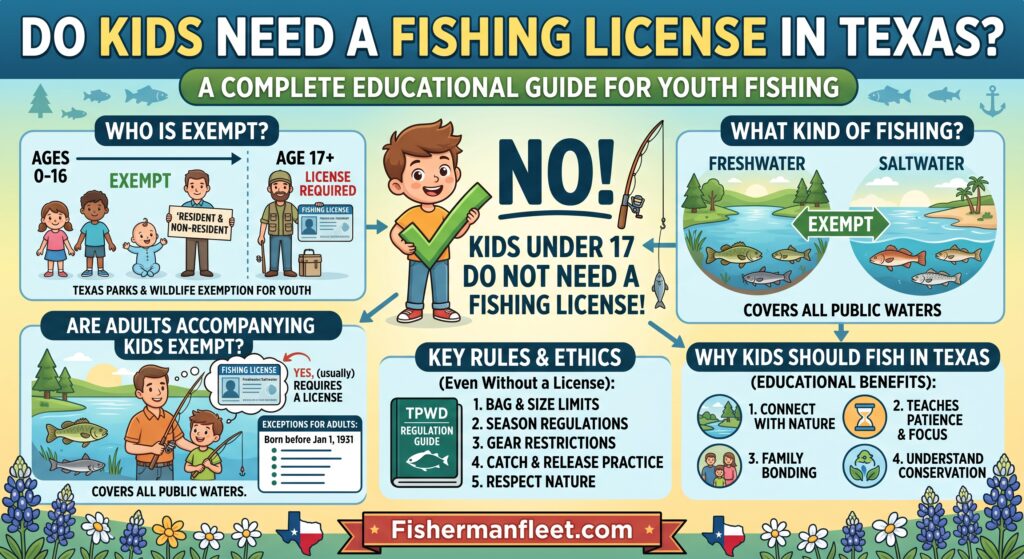
No. Kids under 17 do not need a fishing license in Texas. This exemption applies to both Texas residents and nonresidents fishing in Texas public waters, according to the Texas Parks & Wildlife Department fishing license requirements.
That makes Texas an attractive place for parents, grandparents, and guardians who want to introduce children to freshwater or saltwater fishing without purchasing a separate youth fishing license. However, being exempt from the license requirement does not mean children can ignore fishing regulations. Size limits, bag limits, legal fishing methods, protected species rules, and waterbody-specific regulations can still apply.
Once the family understands the rules, preparing the right tackle can make the experience much more enjoyable. Anglers can explore rods, reels, lures, hooks, fishing line, and other equipment through Fisherman Fleet.
This guide answers do kids need a fishing license, explains why you need a fishing license to fish, and explores related topics such as where to catch largemouth bass, where to find walleye, and how white fishing lures can fit into a freshwater tackle box.
Table of Contents
- Do Kids Need a Fishing License in Texas?
- What Happens When a Child Turns 17?
- Can Kids Fish Free in Texas State Parks?
- Why Do You Need a Fishing License to Fish?
- Why Do People Enjoy Fishing?
- Where to Catch Largemouth Bass
- Where to Find Walleye
- White Fishing Lures and Baits
- Best Fishing Gear for Kids
- Texas Family Fishing Tips
- Frequently Asked Questions
Do Kids Need a Fishing License in Texas?
Texas makes the basic youth rule straightforward: resident and nonresident anglers under 17 are exempt from the state’s fishing-license requirement.
Therefore, a 7-year-old, 12-year-old, or 16-year-old can generally fish Texas public waters without purchasing a fishing license.
The situation changes once the angler reaches 17.
Texas requires residents fishing public waters to have the applicable license unless another exemption applies. Nonresidents generally require a nonresident fishing license once they are 17, again subject to specific exemptions.
Do Fishing Regulations Still Apply to Kids?
Yes.
This is an important distinction for parents researching do kids need a fishing license.
License exemption and fishing-rule exemption are not the same thing. Texas educational material specifically notes that fishing regulations continue to apply to youth who are not required to purchase a license.
Depending on where and what the child fishes for, families should check rules involving:
- Daily bag limits
- Possession limits
- Minimum or maximum lengths
- Legal fishing methods
- Species restrictions
- Special waterbody regulations
- Seasonal regulations
Checking the rules before leaving home can also become part of teaching a young angler responsible fishing practices.
What Happens When a Child Turns 17?
At age 17, Texas fishing-license requirements generally begin.
For freshwater fishing, Texas currently offers a resident freshwater package that includes a fishing license and freshwater endorsement. Saltwater and all-water packages are also available. The correct choice depends on where the angler intends to fish.
As of August 3, 2026, Texas also requires individuals age 17 and older to satisfy identification requirements when obtaining recreational hunting or fishing licenses. Online purchasers must complete the applicable identity-validation process.
Because regulations, fees, and purchasing procedures can change, use the official Texas Parks & Wildlife Department license page before buying.
Can Kids Fish Free in Texas State Parks?
Texas provides another valuable opportunity for families.
TPWD says fishing is available without a fishing license from the bank or pier within Texas State Parks under its free-fishing opportunities. Normal park entry fees and fishing regulations can still apply.
Because children under 17 already qualify for the youth license exemption, state parks can be especially convenient when adults also want an easy introduction to fishing.
Texas has more than 70 state-park locations associated with its free-fishing opportunity, according to TPWD. Some locations also participate in a tackle-loaner program where equipment can be borrowed.
Neighborhood Fishin’ for Kids
Families can also consider TPWD’s Neighborhood Fishin’ program.
These urban lakes and ponds are designed to provide accessible fishing opportunities. TPWD notes that kids under 17 fish without a license, while adults fishing these locations need the appropriate license.
The program includes stocked waters and locations with amenities such as parking and shoreline access, which can make them practical starting points for families.
Why Do You Need a Fishing License?
People sometimes ask, why do you need a fishing license when fish live naturally in public lakes and rivers?
One major reason is conservation.
TPWD states that 100% of license fees fund on-the-ground conservation efforts, while its beginner-fishing resources say fishing-license revenue supports conservation and the future of fishing in Texas.
License revenue can therefore support the broader system that keeps recreational fishing sustainable.
Why Do You Need a Fishing License to Fish?
Fishing licenses also form part of the state’s system for managing public fisheries.
Healthy fisheries require more than simply putting fish in a lake. Agencies monitor fish populations, maintain fishing opportunities, establish regulations, manage habitat, and provide public access and education.
Licenses help fund that work while giving wildlife agencies a framework for regulating recreational fishing.
For young anglers, learning why licenses exist is a useful introduction to conservation. Fishing is not simply about catching a fish. Responsible anglers also protect the resource so future generations can enjoy it.
Why Do People Like Fishing?
Another surprisingly popular question is why do people like fishing?
There isn’t one universal answer.
Fishing combines outdoor recreation, skill, patience, exploration, and the possibility of catching something unexpected.
For families, it also creates an activity that children and adults can enjoy together.
Why Do People Enjoy Fishing?
Some people enjoy the challenge.
Others enjoy exploring lakes and rivers or simply spending several quiet hours outdoors.
Fishing can teach children practical skills such as:
- Casting
- Knot tying
- Bait selection
- Fish identification
- Patience
- Observation
- Catch-and-release techniques
- Respect for wildlife
TPWD describes fishing as an outdoor activity that can be enjoyed with friends and family or individually, and its beginner programs provide educational opportunities for people learning the sport.
For parents, a child’s first bluegill or bass can turn an ordinary afternoon at a pond into a memorable experience.
Where to Catch Largemouth Bass
For anglers interested in largemouth fishing, habitat is more important than simply casting randomly across a lake.
Largemouth bass frequently relate to structure and cover that provide opportunities to ambush prey.
Look around:
- Aquatic vegetation
- Fallen trees
- Docks
- Points
- Creek channels
- Submerged timber
- Rock transitions
- Shaded banks
- Drop-offs
Early morning and evening can provide productive shallow-water opportunities, although bass location changes with weather, season, water temperature, available forage, and individual waterbody conditions.
Where to Catch Largemouth Bass in Texas
Texas offers extensive bass-fishing opportunities in reservoirs, rivers, community lakes, and other freshwater systems.
Rather than assuming a particular lake will always be productive, use current fishing reports and official resources. TPWD’s fishing tools help anglers locate fishing areas and research conditions before traveling.
For families, smaller community lakes can sometimes be more manageable than enormous reservoirs because children can spend more time fishing and less time traveling between locations.
Where to Find Walleye
The keyword where to find walleye requires a different strategy.
Walleye often prefer different habitat and conditions from largemouth bass. Anglers frequently target structure such as rocky areas, points, ledges, deeper transitions, and locations where baitfish concentrate.
The best walleye locations can change considerably throughout the year.
During lower-light conditions, walleye may move into shallower feeding areas. At other times, anglers may need to search deeper water and structure.
Texas officially classifies both walleye and largemouth bass as game fish, so anglers should review current rules before targeting or retaining either species.
Are White Fishing Lures Effective?
Yes. White fishing lures deserve a place in many freshwater tackle boxes.
White is particularly useful because it can resemble common forage such as shad and other baitfish.
Popular white lure choices include:
White Spinnerbaits
A white spinnerbait can be effective for bass around vegetation, shallow cover, points, and stained water.
White Soft-Plastic Swimbaits
Soft swimbaits create a baitfish-like profile and can be retrieved through different sections of the water column.
White Jigs
Depending on the trailer and presentation, white jigs can provide an alternative to traditional natural-color patterns.
White Crankbaits
A white or shad-pattern crankbait can imitate fleeing forage while allowing anglers to cover water quickly.
White Fishing Bait vs Natural Bait
The phrase white fishing bait can refer to artificial baits in white or light-colored patterns rather than one particular type of bait.
Color should not be considered independently from presentation.
Successful lure selection also depends on:
- Water clarity
- Depth
- Forage
- Weather
- Season
- Retrieval speed
- Target species
Instead of filling a tackle box with dozens of nearly identical colors, beginners can start with several versatile natural, dark, and light patterns and learn how fish respond under different conditions.
Best Fishing Gear for Kids
A child’s fishing setup should prioritize manageable equipment rather than maximum power.
A lightweight rod-and-reel combination can make casting easier and reduce fatigue.
Consider carrying:
- Lightweight fishing rod
- Simple spinning or spincast reel
- Appropriate fishing line
- Small hooks
- Bobbers
- Sinkers
- Soft plastic baits
- White fishing lures
- Fishing pliers
- Small tackle box
- Landing net
- Measuring device
- Appropriate personal flotation device where needed
Parents should supervise children closely around hooks, knives, water, boats, docks, and slippery shorelines.
You can explore fishing tackle, rods, reels, lures, hooks, and accessories through Fisherman Fleet fishing gear when preparing a family fishing setup.
Texas Family Fishing Tips
For a child’s first fishing trip, catching the biggest fish in the lake should not necessarily be the objective.
Keep the first trip manageable.
Choose accessible water, bring snacks and drinking water, protect everyone from the sun, and give children opportunities to participate in casting and bait selection.
A pond filled with active panfish can often provide a better introduction than spending hours targeting a single trophy bass.
Most importantly, teach children how to handle fish responsibly and follow the regulations even though they don’t need a fishing license.
Texas’ Neighborhood Fishin’ locations can be useful because they are designed around accessible fishing opportunities and regularly stocked fisheries.
Frequently Asked Questions
Do kids need a fishing license in Texas?
No. Resident and nonresident children under 17 do not need a Texas fishing license.
Does a 16-year-old need a fishing license in Texas?
No. A 16-year-old falls under Texas’ under-17 fishing-license exemption.
Does a 17-year-old need a fishing license in Texas?
Generally, yes. Texas’ youth fishing-license exemption applies to people under age 17. Other specific exemptions can still apply.
Do nonresident kids need a Texas fishing license?
No. Texas specifically exempts nonresidents under 17 from its fishing-license requirement.
Do kids still have to follow Texas fishing regulations?
Yes. Youth who are exempt from buying a license must still follow applicable fishing regulations.
Why do you need a fishing license to fish?
Fishing-license revenue supports conservation and fisheries management. TPWD states that 100% of its license fees fund conservation efforts.
Where can families go fishing in Texas?
Texas offers public lakes, rivers, reservoirs, Neighborhood Fishin’ locations, community fishing lakes, and fishing opportunities at state parks. TPWD provides tools for finding locations based on distance and waterbody.
Where should I catch largemouth bass?
Look for productive habitat such as vegetation, docks, fallen trees, points, submerged structure, and areas holding prey. Location changes with season and conditions.
Where can I find walleye?
Walleye often relate to rocky structure, points, ledges, depth transitions, and baitfish concentrations. Check current local fishing information before choosing a location.
Are white fishing lures good for bass?
Yes. White spinnerbaits, swimbaits, crankbaits, and other shad-style presentations can be effective for bass, particularly when fish are feeding on light-colored baitfish.
Conclusion
So, do kids need a fishing license in Texas? For children under 17, the answer is no. Texas exempts both resident and nonresident youth under 17 from its fishing-license requirement.
Children still need to follow applicable fishing regulations, making their early fishing trips a great opportunity to learn about conservation, responsible fish handling, and sustainable angling.
Whether your family wants to discover where to catch largemouth bass, search for productive walleye locations, experiment with white fishing lures, or simply spend an afternoon catching panfish together, Texas offers numerous ways for young anglers to get started.
Before heading out, check the latest rules through the Texas Parks & Wildlife Department and prepare your tackle through Fisherman Fleet.
