
Marine Education
Walleye Fishing: Complete USA Guide
Sep
Walleye fishing is popular across the United States because these fish combine strong fighting ability, excellent table quality, and challenging behavior. Walleye live in rivers, natural lakes, and reservoirs, and they are especially well adapted to cooler water and low-light conditions. The U.S. Fish and Wildlife Service walleye profile explains that walleye can occupy clear or turbid water, shallow or deep habitat, and are widespread throughout North America.
For anglers planning a walleye trip, Fisherman Fleet is a useful place to explore spinning reels, rods, fishing line, trolling lures, tackle storage, and other fishing equipment.
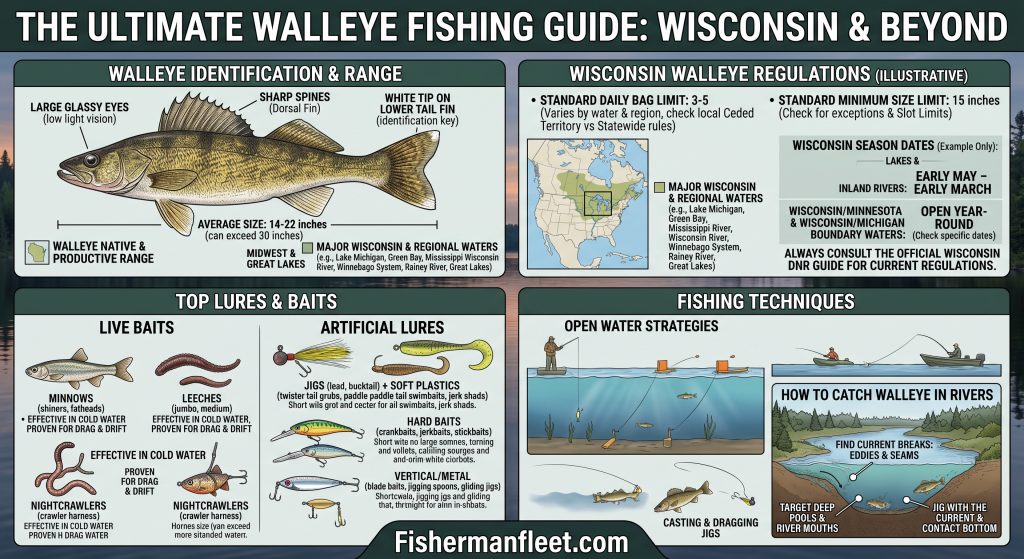
This guide covers best lures to catch walleye, what walleye are attracted to, the best fishing bait for walleye, river techniques, Wisconsin walleye season dates, trolling lures, walleye range, walleye fish size, and how to identify productive fishing water.
Table of Contents
- What Is a Walleye?
- Where Do Walleye Live?
- What Are Walleye Attracted To?
- Best Baits for Walleye
- Best Lures to Catch Walleye
- Walleye Trolling Lures
- Walleye in Rivers
- How to Fish for Walleye in a River
- Wisconsin Walleye Season
- Walleye Fish Size and Range
- Best Waters for Walleye Fishing
- Water Skeeter Pontoon Fishing
- Frequently Asked Questions
- Conclusion
What Is a Walleye?
Walleye, scientifically known as Sander vitreus, are freshwater fish prized throughout much of North America.
Their most distinctive feature is their large eye structure, which helps them see effectively in low-light and turbid conditions.
The Wisconsin Department of Natural Resources walleye guide explains that these large eyes make walleye particularly effective predators in murky water and during periods of reduced light.
That helps explain why productive walleye fishing often occurs:
- Around sunrise
- Around sunset
- During cloudy weather
- In wind-driven stained water
- At night
- In deeper water during bright daylight
The phrases wall eyed fish, wallay fish, wall i fish, and even walleye walleye are common search variations for the same species.
Walleye Range in North America
The walleye range covers a large portion of North America.
According to the U.S. Fish and Wildlife Service, walleye are native to the Great Lakes and Mississippi River drainage basins and have also been introduced into many additional waters for recreational fishing.
Important walleye regions include:
- Great Lakes
- Upper Midwest
- Northern Plains
- Mississippi River system
- Large northern reservoirs
- Canadian border waters
States well known for walleye fishing include Wisconsin, Minnesota, Michigan, Ohio, North Dakota, South Dakota, and parts of New York and Pennsylvania.
What Are Walleye Attracted To?
If you’re asking what are walleye attracted to, start with their natural food.
Adult walleye feed mainly on other fish. The U.S. Fish and Wildlife Service notes that young fish eat small insects before shifting toward prey that can include leeches, snails, frogs, crayfish, and especially fish as they mature.
Walleye are often attracted to:
Baitfish Profiles
Minnow-shaped lures can imitate common prey.
Flash
Metallic finishes and spinner blades can help attract fish in stained or deep water.
Vibration
Crankbaits, spinners, and vibrating presentations help fish detect potential prey.
Natural Movement
Live minnows, leeches, and nightcrawlers can produce subtle movement that walleye readily investigate.
Low-Light Conditions
Because walleye see effectively in dim conditions, dawn, dusk, cloud cover, and stained water can create productive opportunities.
What Baits Do Walleye Like?
The question what baits do walleye like has several good answers.
The Wisconsin DNR identifies minnows, leeches, nightcrawlers, and small plugs as favorite walleye baits and presentations.
Minnows
Minnows are among the classic walleye baits.
They can be fished:
- Below floats
- On jig heads
- With live-bait rigs
- Along current seams
Nightcrawlers
Nightcrawlers can be effective with spinner harnesses and bottom rigs.
Leeches
Leeches are especially popular during warmer periods.
Artificial Soft Plastics
Soft-plastic minnows, paddletails, and worms can imitate natural forage without requiring live bait.
Best Fishing Bait for Walleye
The best fishing bait for walleye depends on the season and location.
A practical seasonal approach is:
Early Spring
Minnows and jigs can be highly effective.
Late Spring
Minnows, plastics, and small crankbaits can all work well.
Summer
Crawler harnesses, leeches, trolling crankbaits, and deep-water presentations become useful.
Fall
Larger minnows, jigs, crankbaits, and slow presentations can become productive as water temperatures cool.
Rather than relying on only one bait, match the presentation to local forage and fish depth.
Best Lures to Catch Walleye
The best lures to catch walleye generally imitate small fish or create enough vibration and flash to help walleye locate them.
Popular options include:
- Jigs
- Crankbaits
- Minnow plugs
- Spinner rigs
- Blade baits
- Soft-plastic paddletails
- Spoons
Jigs for Walleye Fishing
Jigs are among the most versatile walleye lures.
They can be tipped with:
- Minnows
- Nightcrawlers
- Leeches
- Soft plastics
A jig can be vertically presented below a boat, drifted along structure, or cast toward current seams and shorelines.
Crankbaits for Walleye
Crankbaits work especially well when fish are spread across larger areas.
They can imitate:
- Shad
- Shiners
- Perch
- Other forage fish
Depth matters greatly.
The lure should run near the depth where walleye are actually feeding.
Walleye Trolling Lures
Walleye trolling lures are especially useful for covering large lakes, reservoirs, and broad river sections.
Common trolling choices include:
- Deep-diving crankbaits
- Minnow-style plugs
- Spinner harnesses
- Crawler rigs
Trolling allows anglers to systematically search different:
- Depths
- Speeds
- Structures
- Water temperatures
Best Walleye Trolling Lures
The best walleye trolling lures depend on fish depth and forage.
Minnow Crankbaits
Excellent for imitating baitfish.
Deep-Diving Crankbaits
Useful when fish hold deeper.
Spinner Harnesses
Very effective when paired with crawlers.
Jointed Plugs
Provide increased movement and vibration.
A productive trolling strategy is to vary speed and depth until fish reveal a pattern.
Once bites occur consistently, repeat that exact combination.
Good Walleye Trolling Lures
Good walleye trolling lures should offer:
- Predictable running depth
- Stable action
- Strong hooks
- Baitfish-like profile
- Useful vibration
Color can matter, but lure depth and location often matter more.
In clear water, natural baitfish colors may be useful.
In stained water, brighter or higher-contrast patterns can sometimes help fish locate the lure.
Walleye in Rivers
Walleye in rivers often use current strategically.
Rather than constantly fighting strong flow, they commonly position around areas where current brings food within reach without requiring excessive energy.
Look for:
- Current seams
- Eddies
- Wing dams
- Bridge pilings
- Rock points
- Deep holes
- Channel edges
- Dam tailwaters
Walleye are naturally adapted to both lakes and rivers. The U.S. Fish and Wildlife Service specifically identifies rivers, natural lakes, and reservoirs as important habitat.
How to Fish for Walleye in a River
If you’re learning how to fish for walleye in a river, begin by understanding current.
Fish often use areas where fast and slow water meet.
Fish Current Seams
Cast along the boundary between faster and slower current.
Work Deep Holes
Walleye may hold in deeper pools during bright daylight.
Target Rock
Rocky areas can attract forage and create current breaks.
Fish Below Dams
Tailwaters can concentrate both baitfish and predator species.
Use Controlled Jigging
A jig should stay near the bottom without dragging uncontrollably.
Adjust jig weight until you can maintain bottom contact while still fishing naturally.
How to Catch Walleye in the River
To improve your chances when learning how to catch walleye in the river, consider combining location, bait, and time of day.
A simple river setup can include:
Rod: Medium-light or medium spinning rod
Reel: 2000–3000 size spinning reel
Line: Braid or monofilament appropriate to the technique
Leader: Fluorocarbon when desired
Lure: Jig with minnow-style plastic or natural bait
Cast slightly upstream and allow the presentation to move naturally through likely holding water.
Maintaining contact with the lure is important because some walleye strikes can feel subtle.
Wisconsin Walleye Season
The keyword walleye season WI is especially important because Wisconsin is one of America’s most popular walleye destinations.
For the 2026–2027 Wisconsin fishing season, the statewide general inland walleye season opened May 2, 2026 and runs through March 7, 2027.
The Wisconsin DNR 2026 fishing-season announcement confirms that the statewide general inland fishing opener occurred Saturday, May 2, 2026.
However, not every water follows identical rules.
Wisconsin DNR specifically warns that exceptions exist and anglers should check special county and water-specific regulations before fishing.
WI Fishing Opener
For anglers searching WI fishing opener, Wisconsin traditionally holds its general opener on the first Saturday in May.
In 2026, that date was:
Saturday, May 2, 2026
The current general inland fishing season continues through March 7, 2027.
Anglers aged 16 and older generally need an appropriate Wisconsin fishing license, subject to the state’s specific rules.
Before planning a trip, review the Wisconsin DNR fishing seasons and current regulations.
Wisconsin Walleye Spawning Season
Walleye become especially active around their spring spawning migrations.
According to the Wisconsin DNR walleye species guide, spawning migration typically begins after ice-out at water temperatures around 38–44°F.
Wisconsin spawning generally occurs from approximately mid-April through early May, with peak spawning commonly occurring around 42–50°F.
This seasonal movement can concentrate fish around:
- Tributaries
- Rocky shorelines
- Gravel areas
- Current
- Shallow spawning habitat
Walleye Fish Size
The walleye fish size anglers encounter varies considerably.
Many recreational catches fall into moderate size ranges, but exceptionally large fish can become much longer.
The U.S. Fish and Wildlife Service reports that the largest walleye on record in its species profile measured 42 inches long.
Fish growth depends on:
- Water temperature
- Forage availability
- Population density
- Habitat quality
- Genetics
- Age
The agency also notes that reported walleye can live as long as 29 years.
Best Waters for Walleye Fishing
The best waters for fishing depend on the region, but walleye can inhabit several major freshwater environments.
Natural Lakes
These are classic walleye waters throughout the northern United States.
Reservoirs
Large reservoirs can support excellent populations.
Rivers
Rivers offer current-oriented opportunities throughout much of the year.
Great Lakes
The Great Lakes support major walleye fisheries, particularly Lake Erie.
Understanding Fishing Water
The phrase fishing water can mean much more than simply locating a lake.
Walleye location depends heavily on:
- Depth
- Temperature
- Water clarity
- Structure
- Current
- Wind
- Baitfish
- Light level
The U.S. Fish and Wildlife Service explains that walleye can live in both clear and turbid water and in shallow or deep environments, although they favor cool conditions rather than warm water.
That versatility is one reason walleye fisheries exist across such a broad range of North America.
Why Wind Can Improve Walleye Fishing
Experienced anglers frequently talk about the walleye chop.
Wind can stir sediment and create reduced visibility.
The U.S. Fish and Wildlife Service notes that anglers often experience good fishing during windy periods because walleye’s strong vision allows them to hunt effectively in disturbed, turbid water.
Wind can also push:
- Plankton
- Baitfish
- Warm surface water
- Food toward shore
Windblown points and shorelines can therefore be excellent areas to investigate.
Water Skeeter Pontoon Fishing
A Water Skeeter pontoon or similar small fishing pontoon can provide access to calm lakes and protected waters where portability is valuable.
Small personal pontoons can be useful for:
- Jigging
- Casting
- Exploring protected coves
- Reaching nearshore structure
- Fishing small lakes
However, suitability depends on the exact Water Skeeter pontoon boat model, manufacturer specifications, weight capacity, local regulations, weather, and water conditions.
Always confirm:
- Rated capacity
- Approved water conditions
- Required flotation devices
- Motor compatibility
- Inflation requirements
- Manufacturer operating limits
Do not use a small personal pontoon in conditions beyond its design limits.
Choosing Walleye Fishing Gear
A versatile walleye setup does not need to be complicated.
Jigging Setup
A medium-light spinning rod provides sensitivity for detecting subtle strikes.
Trolling Setup
A moderate-action rod can help manage crankbaits and trolling rigs.
Fishing Line
Braid offers sensitivity, while monofilament provides additional stretch. Fluorocarbon is commonly used as leader material.
Tackle Box
Carry several:
- Jig weights
- Soft plastics
- Crankbaits
- Spinner rigs
- Swivels
- Leaders
For rods, reels, trolling lures, line, and additional walleye equipment, explore Fisherman Fleet.
Frequently Asked Questions
What are the best lures to catch walleye?
Jigs, minnow-style crankbaits, spinner rigs, soft-plastic minnows, blade baits, and trolling plugs are among the most versatile choices.
What are walleye attracted to?
Walleye respond to prey-like movement, vibration, flash, natural baitfish profiles, and available forage. They are also particularly effective predators in low-light and turbid conditions.
What baits do walleye like?
Minnows, leeches, and nightcrawlers are traditional choices. The Wisconsin DNR specifically identifies these among popular walleye baits.
What is the best fishing bait for walleye?
Minnows are one of the strongest all-around choices, but nightcrawlers and leeches can be excellent depending on season and water conditions.
How do you fish for walleye in a river?
Look for current seams, deep holes, rocky structure, channel edges, dams, and other current breaks. Jigs tipped with minnows or soft plastics are versatile river presentations.
What are the best walleye trolling lures?
Deep-diving crankbaits, minnow plugs, spinner harnesses, and crawler rigs are popular options. Choose running depth based on where fish are located.
When is walleye season in Wisconsin?
For 2026–2027, Wisconsin’s general inland walleye season runs from May 2, 2026 through March 7, 2027, although special water-specific regulations may apply.
When was the 2026 Wisconsin fishing opener?
Wisconsin’s statewide general inland fishing opener was May 2, 2026.
How large can walleye get?
The U.S. Fish and Wildlife Service reports a maximum recorded length of 42 inches in its walleye species profile.
Where do walleye live?
Walleye inhabit rivers, natural lakes, and reservoirs and are widespread throughout North America.
Are Water Skeeter pontoons suitable for walleye fishing?
They can be useful on appropriate protected waters, depending on the exact model and manufacturer limits. Always verify capacity, safety requirements, and weather conditions before use.
Conclusion
Walleye fishing becomes much easier when anglers understand how the species uses water, responds to prey, and changes location throughout the seasons.
Walleye live in rivers, natural lakes, and reservoirs, and their exceptional vision gives them an advantage in low-light and turbid conditions. The U.S. Fish and Wildlife Service notes that adult walleye feed primarily on other fish, making minnows, crankbaits, soft-plastic baitfish, and other prey-imitation presentations logical choices.
For anglers learning how to catch walleye in the river, concentrate on current seams, rock, channel transitions, deep holes, and other locations that allow fish to feed efficiently without constantly fighting strong flow.
Trolling is another excellent technique. The best walleye trolling lures often include minnow-style crankbaits, deep divers, spinner harnesses, and crawler rigs, with depth and speed adjusted until a productive pattern develops.
Wisconsin anglers should pay particular attention to regulations. The state’s 2026–2027 general inland walleye season opened May 2, 2026 and runs through March 7, 2027, but special rules can apply to individual waters. Check the Wisconsin DNR walleye regulations before each trip.
For spinning rods, reels, fishing line, jigs, trolling lures, tackle boxes, and other equipment for freshwater fishing, explore Fisherman Fleet.
