
Marine Education
Best Size Hook for Catfish: Complete USA Fishing Guide
Sep
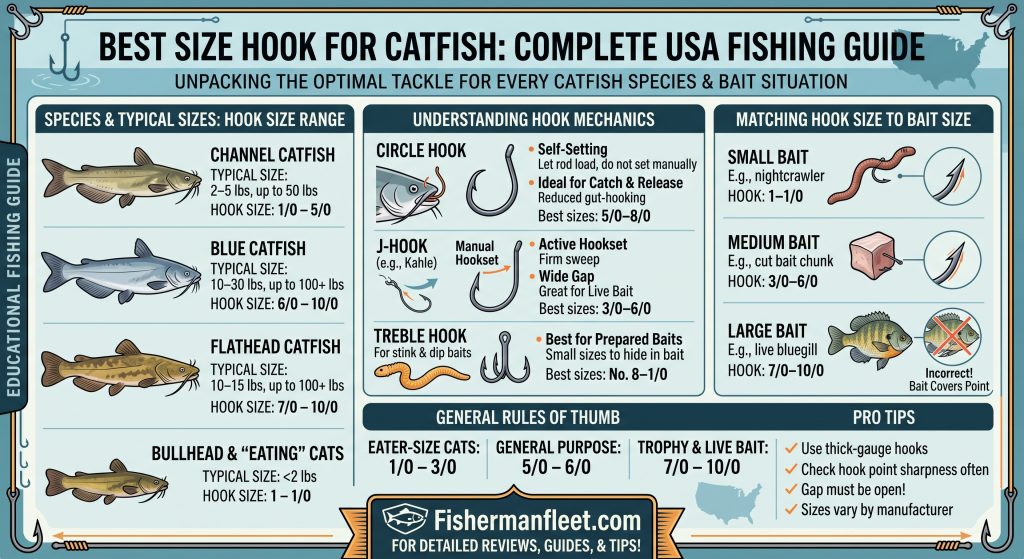
The best size hook for catfish depends on the catfish species, expected fish size, bait, fishing technique, and the particular hook design being used. For many common channel and blue catfish situations, 5/0 to 8/0 circle hooks provide a practical starting range, while smaller hooks can work with smaller baits and larger hooks may be appropriate when targeting trophy-size fish with substantial natural baits.
Hook numbers are not perfectly standardized among manufacturers. A 6/0 circle hook from one company can have different dimensions from another company’s 6/0. For that reason, anglers should consider the actual hook gap, wire strength, bait size, and target fish rather than choosing solely by the number printed on the package.
Circle hooks are particularly useful when fishing natural bait because their design encourages the hook to catch near the fish’s jaw or mouth rather than requiring an aggressive hookset. NOAA Fisheries catch-and-release guidance recommends considering circle hooks, barbless hooks, or hooks with crimped barbs when practicing catch-and-release because appropriate hook selection can help improve survival and make hook removal easier.
Anglers preparing for catfish, striped bass, freshwater, or fly-fishing trips can also explore hooks, rods, reels, fishing line, lures, and tackle at Fisherman Fleet.
Table of Contents
- What Size Hook for Catfish?
- Best Size Hook for Catfish by Fishing Situation
- What Size Circle Hook for Catfish?
- Is a 6/0 Circle Hook Good for Catfish?
- Best Hook for Catfish
- Good Hooks for Catfish
- Catfish Circle Hooks and Proper Hooksets
- What Is Fly Fishing?
- How Does Fly Fishing Work?
- What Size Hook for Striped Bass?
- Circle Hooks for Striped Bass
- Frequently Asked Questions
- Conclusion
What Size Hook for Catfish?
If you’re wondering what size hook for catfish to use, there isn’t one size that works perfectly in every situation.
A useful general starting guide is:
| Fishing Situation | Practical Starting Hook Range |
|---|---|
| Small channel catfish | 2/0–4/0 |
| General channel catfish | 3/0–6/0 |
| Medium blue catfish | 5/0–8/0 |
| Larger blue catfish | 7/0–10/0+ |
| Flathead catfish with live bait | 6/0–10/0+ |
| General-purpose catfish circle hook | 5/0–8/0 |
These ranges should be treated as practical starting points, not universal rules.
A particularly important factor is bait size.
The hook needs enough exposed gap to work correctly after the bait has been attached. Stuffing a large piece of cut bait onto a small hook can fill the hook gap and potentially interfere with a secure hookup.
At the same time, using an unnecessarily oversized hook with a tiny bait can make the presentation less practical.
Best Size Hook for Catfish by Fishing Situation
Choosing the best size hook for catfish becomes easier when you start with the species and fishing method.
Channel Catfish
Channel catfish can range from relatively small fish to impressive adults.
For general fishing, hooks around 3/0 to 6/0 provide a useful starting point.
Smaller presentations may work well with smaller hooks, while anglers using larger pieces of cut bait can move upward.
Blue Catfish
Blue catfish can reach substantial sizes and are frequently targeted using cut bait.
A 5/0 to 8/0 circle hook provides a versatile starting range for many situations.
Anglers intentionally targeting very large blues may use larger hooks, particularly when the bait itself requires additional hook gap.
Flathead Catfish
Flatheads are frequently targeted using larger live or natural baits.
That can justify hooks in approximately the 6/0 to 10/0+ range, depending on bait size and target fish.
The hook must be strong enough for the tackle and fish being pursued while leaving adequate gap after the bait is attached.
What Size Circle Hook for Catfish?
For anglers asking what size circle hook for catfish, approximately 5/0 to 8/0 is a versatile range for many recreational situations.
However, there is an important distinction between selecting a hook based on the fish and selecting one based on the bait.
Suppose you’re targeting moderate-size catfish but using a large chunk of cut shad.
A small hook might technically be capable of landing the fish, but the bait could obstruct too much of the hook gap.
In that situation, moving to a larger circle hook may improve the presentation.
Consider four factors:
Target fish: How large are the catfish you realistically expect?
Bait: How much hook gap will remain after attaching the bait?
Tackle: Is the hook appropriate for your line, rod, and drag setup?
Hook construction: Is the wire strength appropriate for the target species?
Is a 6/0 Circle Hook Good for Catfish?
A 6/0 circle hook for catfish is one of the most versatile sizes anglers can keep in their tackle box.
It can be particularly useful for:
- Channel catfish
- Medium blue catfish
- Cut bait
- Prepared natural bait
- General river fishing
- Lake and reservoir catfishing
However, don’t assume every 6/0 circle hook is physically identical.
Manufacturer sizing varies.
Look at the actual dimensions and especially the hook gap.
The bait should remain secure without completely blocking the gap between the point and shank.
Why Catfish Circle Hooks Are Popular
Catfish circle hooks are popular because they work especially well with bait-and-wait fishing techniques.
Instead of violently setting the hook when a bite occurs, anglers generally allow the fish to load the rod and let the circle hook rotate toward the corner of the mouth.
This can be especially useful when:
- Fishing from shore
- Using multiple rods
- Fishing from an anchored boat
- Using cut bait
- Using live bait
- Practicing catch-and-release
The NOAA Fisheries catch-and-release best practices specifically lists circle hooks among the gear choices anglers can consider to help reduce stress and improve release outcomes.
How to Fish a Circle Hook for Catfish
One of the biggest mistakes beginners make with circle hooks is treating them exactly like traditional J-hooks.
When a catfish takes the bait, resist the instinct to immediately jerk the rod upward with a dramatic hookset.
Instead, allow the line to tighten and the rod to load.
As pressure increases, the circle hook is designed to move toward the fish’s mouth and catch around the jaw area.
Once the rod is loaded, maintain pressure and begin fighting the fish.
Exact technique varies with the hook, rig, bait, current, and fishing situation, so anglers should also follow the hook manufacturer’s recommendations.
Best Hook for Catfish
The best hook for catfish depends on how you’re fishing.
Circle Hooks
Excellent for:
- Cut bait
- Live bait
- Rod-holder fishing
- Bank fishing
- Catch-and-release
Octopus Hooks
Useful for:
- Natural bait
- Smaller presentations
- Situations requiring a compact hook
J-Hooks
Useful when:
- The angler wants to control the hookset
- Fishing certain artificial presentations
- Using techniques where an immediate hookset is appropriate
Treble Hooks
Often associated with some prepared or dough-style baits, although local regulations and intended release practices should always be considered.
For general bait fishing, a strong circle hook is one of the most practical starting choices.
Good Hooks for Catfish
Good hooks for catfish should have more than an appropriate size.
Look for:
Strong Wire
Large catfish can place substantial pressure on terminal tackle.
Sharp Point
A sharp hook improves penetration.
Appropriate Gap
The hook needs sufficient open space after the bait is attached.
Corrosion Resistance
This becomes especially useful when tackle is regularly exposed to water and humid storage conditions.
Appropriate Design
Choose a circle, J, octopus, or other hook pattern according to the fishing method rather than simply buying the largest hook available.
You can explore hooks and other terminal tackle alongside rods, reels, line, and fishing accessories at Fisherman Fleet.
What Is Fly Fishing?
The supporting question what is fly fishing describes a very different style of angling from traditional catfish bait fishing.
Fly fishing is a fishing method where anglers use specialized fly line, a fly rod, fly reel, leader, and an artificial fly designed to imitate insects, baitfish, crustaceans, or other food.
One major difference is the casting system.
With conventional fishing, the weight of a sinker or lure helps carry the line toward the target.
In fly fishing, the weighted fly line itself provides much of the energy needed to deliver the comparatively lightweight artificial fly.
That distinction is central to the fly fishing definition.
Fly Fishing Meaning
A simple fly fishing meaning is:
Fishing with specialized tackle in which an artificial fly is presented using a weighted fly line and fly rod.
Artificial flies can imitate:
- Mayflies
- Caddisflies
- Midges
- Terrestrial insects
- Baitfish
- Crustaceans
- Leeches
- Other aquatic prey
Fly fishing is strongly associated with trout, but it isn’t limited to trout.
Anglers use fly tackle for bass, panfish, salmon, carp, pike, striped bass, redfish, tarpon, bonefish, and many other species.
Define Fly Fishing
To define fly fishing more precisely, think of it as both a casting system and a method of presenting artificial flies.
The angler uses the mass of the fly line to make a controlled cast.
A leader connects the fly line to the artificial fly.
Different fly patterns can be presented:
- On the surface
- Just beneath the surface
- Through the middle of the water column
- Near the bottom
This makes fly fishing far more versatile than the stereotype of simply casting tiny dry flies to trout.
How Does Fly Fishing Work?
Understanding how does fly fishing work begins with the equipment.
Fly Rod
Provides leverage and stores energy during the cast.
Fly Reel
Stores fly line and provides line management. Larger fish may also require the reel’s drag system during the fight.
Fly Line
Provides the mass required to cast the lightweight fly.
Leader and Tippet
Create a less-visible connection between the fly line and artificial fly.
Artificial Fly
Represents something the target fish may eat.
The angler casts the fly to likely fish-holding water and then manipulates the presentation according to the fly and species.
A dry fly may drift naturally across the surface.
A streamer may be stripped through the water to imitate a small fish.
A nymph may be presented below the surface to imitate aquatic insect life.
Fly Fishing Definition vs Conventional Fishing
The most important difference is what provides the casting weight.
With conventional spinning or baitcasting equipment, anglers usually cast a weighted lure, sinker, or bait rig.
With fly fishing, the fly itself can be extremely light. The fly line provides the necessary mass to carry the leader and fly toward the target.
Both methods can be highly effective.
Neither is universally better.
The right approach depends on the species, location, available forage, conditions, and angler preference.
What Size Hook for Striped Bass?
The question what size hook for striped bass requires more caution because striped bass regulations can vary by jurisdiction, bait type, and fishing location.
As a general tackle reference, anglers may encounter hook sizes around 5/0 to 9/0 when fishing natural bait for striped bass, with the exact choice depending heavily on bait size and hook design.
A smaller presentation might use a 5/0 or 6/0 hook.
Larger live or chunk baits can justify a 7/0, 8/0, or 9/0 hook.
But regulations come first.
According to the current NOAA Fisheries Atlantic striped bass information, striped bass are managed through measures that can include size limits, bag limits, gear restrictions, and seasonal closures in state waters. Federal Atlantic waters remain closed to recreational striped bass fishing.
Always verify the rules for the exact waters you intend to fish.
Circle Hooks for Striped Bass
Circle hooks for striped bass can be particularly important when natural bait is being used because some jurisdictions specifically regulate hook design.
Non-offset circle hooks differ from offset circle hooks because the point isn’t displaced sideways relative to the hook shank.
The purpose is not simply regulatory compliance. Circle-hook designs can also help reduce deep hooking.
NOAA Fisheries catch-and-release guidance recommends circle hooks among several gear choices that can make releasing fish easier and potentially improve survival.
NOAA also emphasizes that some fisheries specifically require circle hooks, making it important to know current regulations before fishing.
Non-Offset Circle Hooks
A non-offset circle hook has its hook point aligned with the plane of the shank rather than bent sideways away from it.
These hooks are increasingly important in fisheries where reducing deep hooking is a conservation priority.
NOAA’s barbless circle hook guidance explains how circle-hook designs can facilitate quicker removal and reduce impacts on released fish and protected species.
When regulations specify a non-offset circle hook, don’t assume any package labeled simply “circle hook” automatically qualifies.
Check the actual design and applicable regulations.
Striper Hook Size
There is no universal striper hook size.
A practical starting range for many bait presentations is approximately 5/0 to 9/0, but the best choice depends on:
- Bait size
- Target fish
- Hook manufacturer
- Fishing method
- Local regulations
- Whether circle hooks are required
- Whether offset hooks are prohibited
For example, a moderate-size baitfish might pair naturally with a 6/0 circle hook, while a substantially larger bait may need additional hook gap.
Avoid choosing hook size based only on the expected weight of the fish.
The hook must also fit the bait correctly.
Catfish Hooks vs Striped Bass Hooks
Catfish and striped bass can both be caught effectively with circle hooks, but the fishing situations are different.
Catfish anglers frequently fish rivers, reservoirs, lakes, and ponds with:
- Cut shad
- Live bait
- Prepared bait
- Other natural presentations
Striped bass anglers may use:
- Live baitfish
- Cut bait
- Eels
- Artificial lures
- Jigs
- Trolling presentations
- Fly-fishing equipment
Consequently, don’t assume a hook that works perfectly for one species is automatically ideal for another.
Hook Size Is Not Completely Standardized
This is one of the most important lessons in selecting fishing hooks.
A 6/0 hook isn’t a precise universal measurement.
Two manufacturers can label hooks 6/0 while producing noticeably different:
- Hook gaps
- Shank lengths
- Wire diameters
- Point configurations
- Overall dimensions
When comparing hooks, examine the physical hook rather than relying solely on the size number.
This becomes particularly important when buying hooks online.
Matching Hook Size to Bait
One of the easiest ways to improve hook selection is to start with the bait.
The hook needs enough exposed gap to function after the bait has been attached.
For cut bait, avoid burying the entire hook point and gap inside a thick chunk.
For live bait, position the hook so the bait can move naturally while keeping sufficient hook exposure.
The correct balance provides:
Enough hook strength for the target fish
Enough gap for reliable hookups
Enough bait security to keep the presentation intact
Frequently Asked Questions
What is the best size hook for catfish?
For many general catfish applications, 5/0 to 8/0 circle hooks provide a versatile starting range. Smaller channel catfish can often be targeted with smaller hooks, while trophy blue and flathead catfish may require larger hooks.
What size hook for catfish should beginners use?
A 5/0 or 6/0 circle hook is a practical starting point for many general-purpose catfish rigs, assuming it matches the bait and expected fish size.
Is a 6/0 circle hook good for catfish?
Yes. A 6/0 circle hook for catfish can be highly versatile for channel catfish and moderate blue catfish, particularly with appropriately sized natural bait.
What size circle hook for catfish should I use with large bait?
Larger pieces of cut bait or large live baits may require 7/0, 8/0, 9/0, or larger hooks so enough hook gap remains exposed.
What are good hooks for catfish?
Strong, sharp circle hooks are excellent for many bait-fishing applications. J-hooks and other designs can also work depending on the technique.
What is fly fishing?
Fly fishing uses specialized fly tackle and artificial flies. Unlike conventional fishing, the weighted fly line provides much of the mass needed to cast the lightweight fly.
How does fly fishing work?
The angler uses a fly rod and weighted fly line to deliver an artificial fly. The fly is then presented to imitate insects, baitfish, crustaceans, or other prey.
What size hook for striped bass?
Approximately 5/0 to 9/0 is a useful general range for many natural-bait presentations, but bait size, hook design, and local regulations determine the appropriate choice.
Are circle hooks good for striped bass?
Yes, particularly for natural-bait fishing. However, hook regulations vary. Always check the regulations for the waters you’re fishing.
What are non-offset circle hooks?
A non-offset circle hook keeps the point in the same plane as the shank rather than bending it sideways. Some fisheries specifically require this configuration.
Can I recreationally fish for striped bass in federal Atlantic waters?
No. NOAA Fisheries currently states that recreational striped bass fishing is prohibited in federal Atlantic waters, although certain transit provisions can apply. Check NOAA Fisheries recreational regulations and your state regulations before fishing.
Conclusion
The best size hook for catfish isn’t determined by one universal number. Hook choice should match the catfish species, bait size, expected fish size, tackle strength, and fishing technique.
For many everyday catfish situations, 5/0 to 8/0 circle hooks provide a versatile starting range. A 6/0 circle hook for catfish is particularly useful for many channel and moderate blue catfish presentations, while anglers targeting large flatheads or trophy blues with substantial bait may need larger hooks.
Circle hooks are also valuable beyond catfishing. They play an important role in striped bass and other fisheries, particularly where conservation-oriented gear regulations apply. NOAA Fisheries recommends anglers check applicable rules because some fisheries specifically require circle hooks.
Meanwhile, understanding what is fly fishing expands an angler’s options even further. Fly fishing uses the mass of specialized fly line to present lightweight artificial flies, making it fundamentally different from conventional baitcasting and spinning techniques.
Whether you’re building a catfish rig, preparing for striped bass, experimenting with fly fishing, or upgrading your terminal tackle, choosing equipment that matches the target species and fishing conditions can make every trip more productive.
For fishing hooks, rods, reels, line, lures, terminal tackle, and other equipment, explore Fisherman Fleet.
