

Marine Education
Largemouth Bass Spawning Season: Complete USA Guide
Sep
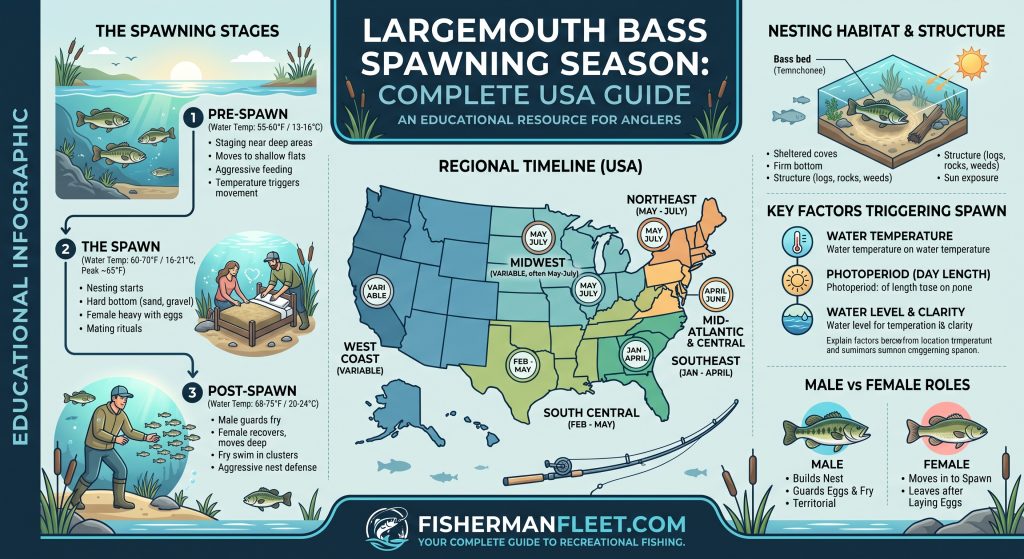
The largemouth bass spawning season is one of the most important periods of the year for bass anglers in the United States. Largemouth bass generally move toward shallower spawning habitat as spring water temperatures rise, but the exact timing varies according to latitude, local climate, elevation, weather patterns, and conditions within an individual lake or river.
According to the Texas Parks and Wildlife Department largemouth bass guide, spawning in Texas begins during spring when water temperatures reach approximately 60°F. Depending on location, this can happen as early as February or as late as May.
This is why anglers should pay attention to water temperature rather than relying exclusively on calendar dates.
Anglers preparing for spring bass fishing can explore spinning reels, bass rods, fishing line, lures, tackle storage, and other equipment at Fisherman Fleet.
Table of Contents
- When Do Largemouth Bass Spawn?
- What Water Temperature Do Bass Spawn?
- Bass Fishing Water Temperature Chart
- When Does Bass Spawning Season Start?
- When Does Spawning Season End for Bass?
- Where Do Largemouth Bass Spawn?
- Pre-Spawn, Spawn, and Post-Spawn Bass
- What Size Spinning Reel for Bass?
- Best Size Spinning Reel for Bass
- Frequently Asked Questions
- Conclusion
When Do Largemouth Bass Spawn?
For anglers wondering when do bass spawn, the straightforward answer is that largemouth bass generally spawn during spring as warming water creates favorable reproductive conditions.
However, spring arrives at very different times throughout the United States.
Bass living in Florida or southern Texas may enter spawning conditions considerably earlier than bass in Michigan, Wisconsin, Minnesota, or New York.
The transition can generally be viewed like this:
Southern United States: Spawning can begin during late winter and continue into spring.
Central United States: Spawning commonly becomes prominent during spring.
Northern United States: Bass generally spawn later in spring, with some populations potentially continuing into early summer depending on conditions.
These periods are guidelines rather than guaranteed dates.
A prolonged warm period can accelerate the seasonal transition, while cold fronts can temporarily slow shallow-water activity.
What Water Temperature Do Bass Spawn?
One of the most important questions for spring anglers is what water temperature do bass spawn?
A useful starting point is approximately 60°F.
The Texas Parks and Wildlife Department reports that largemouth bass spawning begins in spring when water temperatures reach about 60°F. Its aquatic science resources provide the same approximate threshold.
Additional Texas Parks and Wildlife water-temperature guidance identifies approximately 60°F as the temperature at which largemouth bass begin spawning in spring, while describing roughly 65–85°F as their preferred temperature range.
However, anglers should avoid treating 60°F as a universal switch.
Spawning behavior depends on several environmental factors, including:
- Water temperature
- Day length
- Geographic location
- Weather stability
- Water depth
- Available spawning habitat
- Local bass population
The overall warming trend can therefore be more informative than a single temperature reading.
Bass Fishing Water Temperature Chart
| Water Temperature | Likely Bass Behavior | Fishing Approach |
|---|---|---|
| Below 50°F | Generally slower cold-water behavior | Slow presentations around deeper structure |
| 50–55°F | Early pre-spawn movement may develop | Jigs, jerkbaits and slow presentations |
| 55–60°F | Increasing pre-spawn activity | Spinnerbaits, crankbaits, jigs and plastics |
| 60–65°F | Spawning becomes increasingly possible | Search shallow protected habitat |
| 65–75°F | Spawn and post-spawn patterns may overlap | Plastics, moving baits and topwater |
| Above 75°F | Increasing transition toward summer patterns | Vegetation, shade, structure and deeper water |
This bass fishing water temperature chart should be treated as a practical fishing reference rather than a rigid biological timetable.
Texas Parks and Wildlife specifically identifies around 60°F as an important spawning threshold.
When Does Bass Spawning Season Start?
The bass spawning season starts when environmental conditions become suitable for reproduction.
In Texas, the timing demonstrates how much geographic location matters.
The Texas Parks and Wildlife largemouth bass species profile explains that spawning can occur as early as February or as late as May, depending on the location within Texas itself.
Imagine how much greater the variation becomes when comparing Texas with northern states.
Instead of focusing exclusively on the month, watch for several seasonal indicators.
Bass may begin moving from deeper winter habitat toward:
- Creek channels
- Secondary points
- Shallow flats
- Protected coves
- Shoreline vegetation
- Spawning pockets
As conditions improve, male bass begin occupying suitable nesting habitat.
When Do Bass Start Spawning?
Bass start spawning once several favorable environmental conditions come together.
Water temperatures approaching approximately 60°F provide one of the strongest clues.
For example, Texas Parks and Wildlife freshwater hatchery information explains that largemouth bass brood fish are paired for reproduction in early spring as water temperatures reach approximately 60°F.
Wild fish similarly respond to warming spring conditions.
For anglers, a thermometer can therefore become an extremely useful piece of equipment.
Monitor not only the absolute temperature but whether the water has been consistently warming.
Several warm days can push bass toward shallow areas, while a significant cold front can temporarily alter their positioning.
When Does Largemouth Bass Spawn?
Largemouth bass typically spawn during spring, but exact timing depends heavily on location.
When suitable conditions arrive, males move into shallow areas and construct nests.
The Texas Parks and Wildlife Department’s largemouth bass information states that male largemouth bass typically build nests in approximately 2 to 8 feet of water.
They prefer relatively quiet, vegetated areas and can use various substrates except very soft mud.
This means anglers looking for potential spawning habitat should investigate:
- Protected coves
- Shallow flats
- Shoreline cover
- Vegetation
- Protected pockets
- Areas sheltered from heavy waves
- Suitable firm-bottom areas
When Do Black Bass Spawn?
The term black bass includes several related species rather than only largemouth bass.
Largemouth, smallmouth, and spotted bass can have somewhat different spawning preferences.
For example, the Texas Parks and Wildlife smallmouth bass guide reports that male smallmouth bass move into spawning areas as water temperatures approach approximately 60°F.
Meanwhile, Texas Parks and Wildlife spotted bass information indicates that spotted bass may use spawning areas at water temperatures ranging approximately from 57°F to 74°F.
Therefore, anglers searching for information about when do black bass spawn should identify the particular bass species in their lake.
What Happens During the Largemouth Bass Spawn?
Male largemouth bass play an important role in the reproductive process.
After selecting appropriate shallow habitat, males prepare nests.
Females enter suitable spawning areas and deposit eggs.
Texas Parks and Wildlife reports that females may deposit approximately 2,000 to 43,000 eggs. Afterward, males guard the nest. The eggs can hatch within approximately five to ten days, and newly hatched fry remain near the nest under male protection for a period afterward.
This nest-guarding behavior is another reason anglers should handle spawning bass responsibly.
Pre-Spawn Bass Fishing
For many anglers, the pre-spawn period provides some of the most exciting fishing opportunities of the year.
Large female bass move toward spawning areas and frequently stage near structural transitions before moving completely shallow.
Potential locations include:
- Secondary points
- Drop-offs near spawning flats
- Creek channels
- Submerged vegetation
- Standing timber
- Rocky transitions
- Docks
- Laydowns
Useful presentations can include spinnerbaits, jigs, jerkbaits, crankbaits, swimbaits, and soft plastics.
The key is determining the fish’s position along its seasonal migration route.
If the water is still cold, bass may remain near deeper staging areas.
As temperatures rise consistently, investigate progressively shallower water.
Fishing During the Spawn
Once bass begin actively spawning, anglers may encounter fish around visible beds.
Responsible fishing practices become particularly important during this period.
Before fishing, always check current state and local regulations because rules can differ considerably between fisheries.
For example, anglers fishing Texas waters can review the Texas Parks and Wildlife fishing regulations before heading out.
When practicing catch-and-release around spawning areas, minimizing handling and returning fish promptly can reduce unnecessary stress.
When Does Spawning Season End for Bass?
There isn’t a universal date for when spawning season ends for bass.
Individual bass do not necessarily spawn simultaneously, even within the same lake.
During transitional periods, one part of a reservoir may contain spawning fish while other bass have already entered post-spawn behavior.
The end of the spawning period depends on:
- Geographic location
- Water temperature
- Weather
- Lake depth
- Elevation
- Local habitat
- Seasonal warming patterns
As spring progresses into summer, bass increasingly transition away from spawning areas.
Texas Parks and Wildlife notes that largemouth bass in Texas generally begin moving toward deeper water by June.
Post-Spawn Bass Fishing
After spawning, bass begin transitioning toward warmer-season habitat.
Some fish remain relatively shallow for a period, while others move toward:
- Points
- Vegetation
- Drop-offs
- Creek channels
- Offshore structure
- Deeper cover
- Shade
Post-spawn bass can sometimes be challenging because individual fish may be in different stages of recovery and movement.
Topwater presentations can become particularly interesting as conditions continue warming.
What Size Spinning Reel for Bass?
Another important question is what size spinning reel for bass?
For general largemouth bass fishing, a 2500-size spinning reel is an excellent starting point.
It offers a practical balance between:
- Weight
- Line capacity
- Casting performance
- Drag capability
- Versatility
However, reel numbering isn’t perfectly standardized between manufacturers, so anglers should also compare actual reel weight, spool capacity, drag specifications, and intended line size.
2000-Size Spinning Reel
A 2000-size reel can work particularly well for finesse applications.
Consider this size for techniques such as:
- Ned rigs
- Small soft plastics
- Lightweight drop shots
- Small finesse presentations
2500-Size Spinning Reel
For many anglers asking what size reel for bass fishing, this is the versatile middle ground.
It works well for:
- Wacky rigs
- Drop shots
- Ned rigs
- Finesse plastics
- Small swimbaits
- Lightweight hard baits
3000-Size Spinning Reel
A 3000-size spinning reel can provide additional line capacity and may balance better with somewhat heavier spinning rods.
It can be useful when fishing:
- Larger bodies of water
- Heavier line
- Bigger presentations
- More demanding cover
Best Size Spinning Reel for Bass
There isn’t one perfect reel size for every angler, but 2500 is an excellent general-purpose choice.
A versatile setup could combine:
Rod: 6’6″ to 7′ medium or medium-light spinning rod
Reel: 2500-size spinning reel
Line: Select braid, monofilament, or fluorocarbon according to technique and manufacturer recommendations
The entire combination should feel balanced.
A reel that is unnecessarily large can make a lightweight rod feel cumbersome, while a reel that is too small may provide less line capacity than desired.
Anglers looking to prepare their tackle for spring can explore bass rods, reels, lures, fishing line, and accessories at Fisherman Fleet.
How Water Temperature Changes Bass Fishing
Water temperature remains important even after spawning.
The Texas Parks and Wildlife Stillhouse Hollow fishing guide, for example, notes strong largemouth bass fishing during spring and fall when water temperatures range from approximately the mid-50s through the mid-70s at that particular reservoir.
This demonstrates why anglers should think beyond a single spawning temperature.
Ask four questions when you arrive at the lake:
What is today’s water temperature?
Has the water been warming or cooling?
Where is the warmest suitable water?
Are the bass staging, spawning, or transitioning away from spawning areas?
Those observations can be far more useful than simply knowing the month.
Frequently Asked Questions
When does largemouth bass spawning season begin?
Largemouth bass generally begin spawning as water temperatures rise during spring. Approximately 60°F is an important benchmark, although exact timing varies by location. The Texas Parks and Wildlife Department reports that spawning in Texas can begin as early as February or as late as May.
What water temperature do bass spawn?
Largemouth bass spawning commonly begins as spring water temperatures reach approximately 60°F.
When do bass start spawning?
Bass start spawning as warming spring conditions become favorable. Temperature, daylight, weather stability, and suitable habitat all influence timing.
When do bass fish spawn in the South?
Southern largemouth bass can spawn considerably earlier than northern populations. In parts of Texas, spawning may begin as early as February.
When do black bass spawn?
Black bass generally spawn during spring as waters warm, but exact temperatures and timing vary among largemouth, smallmouth, and spotted bass.
When does spawning season end for bass?
There is no nationwide end date. Spawning ends progressively as local water temperatures rise and individual fish complete reproduction.
What size spinning reel for bass?
A 2500-size spinning reel is a versatile general-purpose choice for largemouth bass fishing.
What is the best size spinning reel for bass?
For general bass fishing, a 2500-size reel provides an excellent balance between weight, line capacity, and versatility. A 2000 can suit lighter finesse fishing, while a 3000 may be appropriate when additional capacity is desired.
Conclusion
Understanding the largemouth bass spawning season gives anglers valuable insight into where bass are likely to be and how their behavior changes throughout spring.
Rather than relying exclusively on calendar dates, monitor water temperature, weather trends, geographic location, and fish movement. The Texas Parks and Wildlife Department identifies approximately 60°F as an important temperature at which largemouth bass spawning begins in spring.
Southern populations may enter spawning conditions considerably earlier than northern populations, meaning the answer to when does largemouth bass spawn depends heavily on where you fish.
Equipment matters as well. For anglers wondering what size spinning reel for bass, a balanced 2500-size spinning reel is an excellent general-purpose starting point, while 2000 and 3000 sizes can serve more specialized applications.
Before heading out, review the regulations for your fishing destination and prepare appropriate equipment. For spinning reels, bass rods, fishing line, lures, tackle storage, and other fishing equipment, explore Fisherman Fleet.
