

Marine Education
Fresh Water Fish Types: Complete USA Guide
Sep
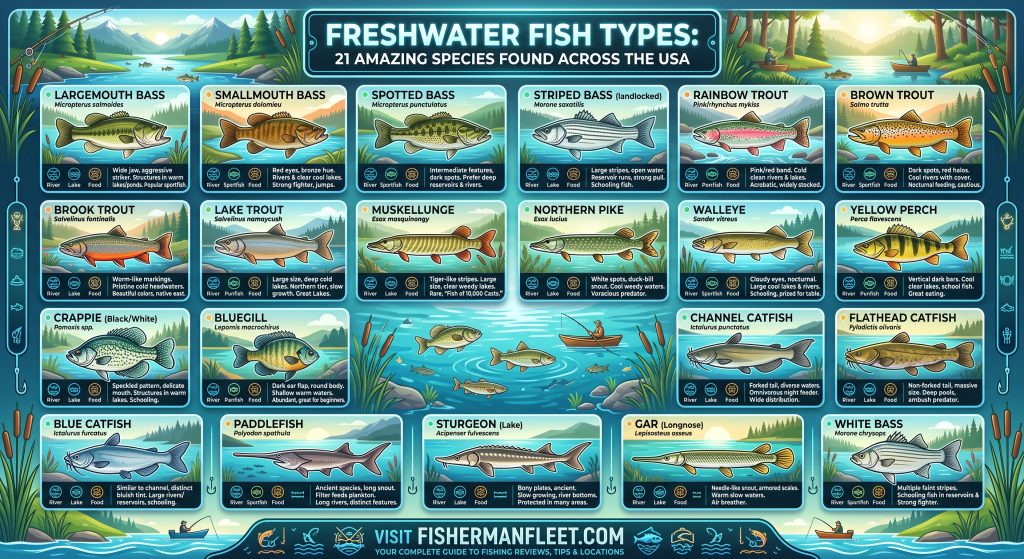
Fresh water fish types in the United States include an enormous range of species living in lakes, rivers, reservoirs, ponds, wetlands, and streams. From largemouth bass and walleye to catfish, crappie, trout, pike, sunfish, and freshwater drum, North America supports remarkably diverse freshwater fish communities.
The U.S. Fish and Wildlife Service freshwater fish collection highlights dozens of species, including largemouth bass, walleye, catfish, crappie, northern pike, trout, and many others.
Anglers can explore fishing rods, reels, lines, lures, hooks, tackle boxes, and other freshwater equipment at Fisherman Fleet.
Table of Contents
- What Are Freshwater Fish?
- Freshwater Species List
- Most Common Freshwater Fish in the USA
- Popular Freshwater Game Fish
- Common Lake Fish
- Common River Fish
- North American Freshwater Fish by Region
- Different Types of Freshwater Fish
- How Freshwater Fish Habitats Differ
- Freshwater Fishing Gear
- Frequently Asked Questions
- Conclusion
What Are Freshwater Fish?
Freshwater fish are species that live primarily in inland waters with relatively low salt concentrations.
These habitats include:
- Lakes
- Rivers
- Streams
- Reservoirs
- Ponds
- Wetlands
- Springs
Some species spend their entire lives in freshwater, while others move between freshwater and saltwater during different stages of their life cycle.
For example, the U.S. Fish and Wildlife Service American eel profile explains that American eels primarily live in rivers and estuaries but migrate to the ocean to reproduce.
That means a freshwater species list can include both permanent freshwater residents and migratory fish that depend heavily on freshwater habitats.
Freshwater Species List
The United States contains hundreds of freshwater fish species.
Some of the most recognizable include:
- Largemouth bass
- Smallmouth bass
- Spotted bass
- Channel catfish
- Blue catfish
- Flathead catfish
- Black crappie
- White crappie
- Bluegill
- Pumpkinseed
- Rainbow trout
- Brown trout
- Brook trout
- Lake trout
- Walleye
- Sauger
- Northern pike
- Muskellunge
- Yellow perch
- Freshwater drum
- Common carp
This is only a small selection of the different kinds of freshwater fish found across North America.
The U.S. Geological Survey freshwater fish range database maintains extensive information about the native ranges of freshwater fishes across North America.
Most Common Freshwater Fish in the USA
The phrase most common freshwater fish can mean different things.
Some species are geographically widespread, while others are especially common among anglers because they are abundant and heavily targeted.
Largemouth Bass
Largemouth bass are among the best-known freshwater game fish in America.
They commonly inhabit:
- Lakes
- Reservoirs
- Ponds
- Slow-moving rivers
- Vegetated backwaters
Bass are highly popular because they aggressively strike artificial lures and can be caught using many techniques.
Common bass presentations include:
- Soft plastics
- Crankbaits
- Spinnerbaits
- Jigs
- Topwater lures
Bluegill
Bluegill are among the most familiar panfish in the United States.
They commonly live in ponds, lakes, reservoirs, and slower sections of rivers.
Their relatively small size and willingness to bite make them especially popular with young or beginning anglers.
Channel Catfish
Channel catfish are widespread across much of the United States.
They thrive in rivers, reservoirs, lakes, and ponds and can be caught using natural baits, prepared baits, and other presentations.
Black Crappie
Black crappie are popular freshwater game fish found in lakes, ponds, reservoirs, and slower waters.
The U.S. Fish and Wildlife Service describes black crappie as a popular freshwater game fish native to lakes, ponds, and slow-moving waters across much of the central and eastern United States.
Rainbow Trout
Rainbow trout are especially important in cold-water fisheries.
They are commonly associated with:
- Mountain streams
- Cold rivers
- Reservoirs
- Stocked lakes
Their popularity makes them an important part of recreational freshwater fishing across many states.
Popular Freshwater Game Fish
A freshwater game fish is generally a species valued by recreational anglers for sport.
Popular examples include:
Largemouth Bass
Known for powerful strikes and exciting fights.
Smallmouth Bass
Often associated with rocky lakes and rivers.
Walleye
Highly valued both as a sport fish and for the table.
The U.S. Fish and Wildlife Service walleye guide notes that walleye live in rivers, natural lakes, and reservoirs and prefer cooler water conditions.
Northern Pike
Aggressive predators known for striking large lures.
Muskellunge
Often called muskie, these large predators are prized by anglers seeking trophy fish.
Trout
Rainbow, brown, brook, and lake trout support major fisheries across different regions of the United States.
Crappie
Both black and white crappie are important recreational species.
Catfish
Channel, blue, and flathead catfish attract anglers across much of the country.
Common Lake Fish
When anglers ask about kinds of fish in lakes, the answer depends heavily on water temperature, depth, habitat, and geographic region.
Common lake fish include:
- Largemouth bass
- Smallmouth bass
- Bluegill
- Crappie
- Walleye
- Yellow perch
- Northern pike
- Catfish
- Trout
- Carp
- Freshwater drum
Large reservoirs can contain several of these species simultaneously.
For example, a lake might support bass and bluegill in shallow vegetated areas, crappie around submerged structure, and walleye in deeper open-water habitat.
Kinds of River Fish
The kinds of river fish found in the USA vary dramatically based on river size, current speed, temperature, elevation, and geographic location.
Common river species include:
- Smallmouth bass
- Channel catfish
- Flathead catfish
- Walleye
- Sauger
- Trout
- Carp
- Freshwater drum
- Suckers
- Sturgeon
The U.S. Fish and Wildlife Service Fish and Aquatic Conservation program notes that America’s freshwater lakes, rivers, and streams support extremely diverse communities, including salmon, trout, Pacific lamprey, river herring, American shad, and striped bass.
Types of Fish in a River
Different types of fish in a river often occupy different habitat zones.
Fast-Current Species
Some fish prefer moving water.
Examples can include:
- Trout
- Smallmouth bass
- Certain suckers
Deep-Pool Species
Larger pools can hold:
- Catfish
- Walleye
- Carp
Backwater Species
Slower river areas can support:
- Largemouth bass
- Crappie
- Bluegill
Bottom-Oriented Species
Species such as catfish and freshwater drum often feed near the bottom.
Understanding these habitat preferences helps anglers choose better fishing locations.
Freshwater Drum
Freshwater drum are particularly interesting because they represent an unusual member of the drum family.
According to the U.S. Fish and Wildlife Service freshwater drum feature, freshwater drum are the only North American drum species that lives entirely in freshwater. They occur across a broad range of lakes, ponds, rivers, and streams.
They can live in both flowing and still water and are capable of becoming relatively large.
Freshwater drum are sometimes overlooked compared with bass or walleye, but they can provide strong fights on rod and reel.
North American Freshwater Fish
The category North American freshwater fish is extremely broad.
It includes:
Bass
- Largemouth bass
- Smallmouth bass
- Spotted bass
Sunfish
- Bluegill
- Pumpkinseed
- Redear sunfish
Catfish
- Channel catfish
- Blue catfish
- Flathead catfish
Trout and Salmon
- Rainbow trout
- Brook trout
- Brown trout
- Lake trout
- Pacific salmon species
Pike Family
- Northern pike
- Muskellunge
- Pickerel
Percids
- Walleye
- Sauger
- Yellow perch
Other Important Fish
- Freshwater drum
- Paddlefish
- Sturgeon
- Carp
- Suckers
- Gar
- Bowfin
The USGS fish presence database documents hundreds of fish species and tens of thousands of sampled stream reaches in the conterminous United States, demonstrating just how diverse American freshwater systems are.
Freshwater Fish America: Regional Differences
The types of fish in USA waters vary by region.
Southeast
Common species include:
- Largemouth bass
- Bluegill
- Crappie
- Channel catfish
- Blue catfish
- Gar
- Bowfin
Warm-water lakes and reservoirs dominate much of the region.
Midwest
Common species include:
- Walleye
- Yellow perch
- Smallmouth bass
- Largemouth bass
- Northern pike
- Crappie
- Catfish
The Great Lakes and thousands of inland lakes make this region especially diverse.
Northeast
Common species include:
- Smallmouth bass
- Largemouth bass
- Brook trout
- Brown trout
- Rainbow trout
- Yellow perch
- Northern pike
West
Western fisheries include:
- Rainbow trout
- Cutthroat trout
- Kokanee
- Largemouth bass
- Smallmouth bass
- Catfish
Pacific Northwest
This region is particularly known for salmonids.
Coho salmon, for example, occur along Pacific coastal regions in California, Oregon, Washington, British Columbia, and Alaska according to the U.S. Fish and Wildlife Service coho salmon guide.
Different Types of Freshwater Fish by Feeding Style
Another way to understand different types of freshwater fish is by how they feed.
Predatory Fish
These actively pursue other animals.
Examples include:
- Bass
- Pike
- Muskie
- Walleye
- Trout
Bottom Feeders
These commonly search for food near the substrate.
Examples include:
- Catfish
- Carp
- Freshwater drum
- Suckers
Panfish
This informal angling category includes smaller species commonly caught for recreation or food.
Examples include:
- Bluegill
- Crappie
- Pumpkinseed
- Yellow perch
Filter or Specialized Feeders
Some species use very different feeding strategies.
Paddlefish, for example, are unlike typical predatory game fish and feed differently from bass or pike.
Freshwater Fish by Water Temperature
Freshwater species can also be grouped broadly by their temperature preferences.
Cold-Water Fish
Examples include:
- Trout
- Salmon
- Lake trout
These fish generally depend on cooler, oxygen-rich water.
Cool-Water Fish
Examples include:
- Walleye
- Northern pike
- Yellow perch
Warm-Water Fish
Examples include:
- Largemouth bass
- Bluegill
- Crappie
- Catfish
- Carp
These groupings help explain why the same species are not found equally everywhere in the United States.
Why Fish Species Differ Between Lakes
Two lakes located only a few miles apart can contain different fish communities.
Factors include:
- Water temperature
- Lake depth
- Dissolved oxygen
- Vegetation
- Water clarity
- Bottom composition
- Connection to rivers
- Natural range
- Fish stocking
- Predator-prey relationships
Human activity also affects distributions.
Some freshwater species have been deliberately stocked outside their historical ranges to create recreational fisheries.
The U.S. Geological Survey tracks native ranges partly because North American freshwater fish have often been moved beyond their original distributions.
Native and Introduced Freshwater Fish
Not every fish found in an American lake is native to that particular watershed.
Some species have been:
- Intentionally stocked
- Accidentally introduced
- Moved between drainage systems
- Expanded through connected waterways
This distinction matters ecologically because introduced populations can sometimes compete with native fish or alter aquatic ecosystems.
For anglers, it also explains why certain famous sport fish may occur far beyond their original native ranges.
Freshwater Game Fish vs Nongame Fish
Not all freshwater fish are commonly targeted by anglers.
Game Fish
Usually receive substantial recreational fishing attention.
Examples include:
- Bass
- Trout
- Walleye
- Pike
- Crappie
Nongame Fish
These may receive less recreational attention but can be ecologically important.
Examples can include:
- Minnows
- Suckers
- Darters
- Shiners
The distinction is usually based on fishing management rather than biological importance.
Every species occupies a role in its ecosystem.
Fish That Live in Freshwater and Saltwater
Some species don’t fit neatly into only one category.
Migratory species may use both fresh and salt water.
Salmon
Many salmon are born in freshwater, migrate to the ocean, and return to freshwater to spawn.
American Eel
American eels essentially do the reverse.
They spend much of their lives in freshwater or estuarine environments and migrate to the ocean to reproduce. The U.S. Fish and Wildlife Service describes American eels as catadromous fish.
Striped Bass
Striped bass populations may move between marine and freshwater environments, while some landlocked populations live in reservoirs.
Therefore, lists of fish that live in freshwater can contain species with very different life histories.
Best Fishing Gear for Freshwater Fish
Different species require different tackle.
Bass
Common equipment includes:
- Spinning reels
- Baitcasting reels
- Medium to medium-heavy rods
- Soft plastics
- Crankbaits
- Jigs
Crappie
Light spinning equipment and small jigs are common.
Trout
Light spinning tackle or fly-fishing equipment can work well.
Catfish
Heavier rods, strong line, circle hooks, and natural bait are common choices.
Walleye
Spinning tackle is especially versatile for jigging and live-bait techniques.
Pike and Muskie
Heavier rods, strong leaders, and larger lures are typically used.
You can explore fishing rods, reels, lines, terminal tackle, lures, and freshwater fishing accessories at Fisherman Fleet.
Frequently Asked Questions
What are the most common fresh water fish types in America?
Common examples include largemouth bass, bluegill, crappie, catfish, trout, walleye, yellow perch, northern pike, carp, and freshwater drum.
What are common lake fish?
Largemouth bass, bluegill, crappie, catfish, walleye, yellow perch, pike, trout, and carp are commonly encountered in American lakes, although species vary by region.
What types of fish live in rivers?
Common river fish include smallmouth bass, catfish, walleye, sauger, trout, carp, freshwater drum, suckers, and sturgeon.
What is a freshwater game fish?
A freshwater game fish is generally a freshwater species actively pursued by recreational anglers. Bass, trout, walleye, crappie, pike, and catfish are common examples.
What is the most common freshwater fish?
There is no single species that is universally the most common throughout the United States. Bluegill, largemouth bass, channel catfish, and several minnow species are widespread, but distribution varies greatly.
What are North American freshwater fish?
North American freshwater fish include bass, sunfish, catfish, trout, salmon, pike, walleye, perch, sturgeon, gar, bowfin, freshwater drum, suckers, and hundreds of smaller species.
Are all freshwater fish native to the waters where they live?
No. Many species have been introduced or stocked outside their historical native ranges.
Are salmon freshwater fish?
Salmon depend heavily on freshwater for reproduction, but many species also spend large portions of their lives in the ocean.
Are American eels freshwater fish?
American eels spend much of their lives in freshwater and estuaries but migrate to the Sargasso Sea to reproduce, according to the U.S. Fish and Wildlife Service.
Conclusion
Understanding fresh water fish types helps anglers recognize the enormous biological diversity found in American lakes, rivers, streams, reservoirs, and ponds.
Some of the most familiar United States fish include largemouth bass, smallmouth bass, bluegill, crappie, channel catfish, walleye, northern pike, trout, yellow perch, and freshwater drum. The U.S. Fish and Wildlife Service maintains educational resources covering dozens of these freshwater species.
However, North American freshwater diversity extends far beyond the species most anglers recognize. The U.S. Geological Survey maintains extensive fish occurrence data across thousands of stream reaches, illustrating the diversity of fish communities throughout the country.
Whether you’re interested in common lake fish, kinds of river fish, freshwater game fish, or different types of freshwater fish, identifying the species and understanding its preferred habitat makes it easier to select appropriate fishing locations and equipment.
For freshwater rods, spinning reels, baitcasting reels, lures, fishing line, hooks, tackle boxes, and other angling equipment, explore Fisherman Fleet.
